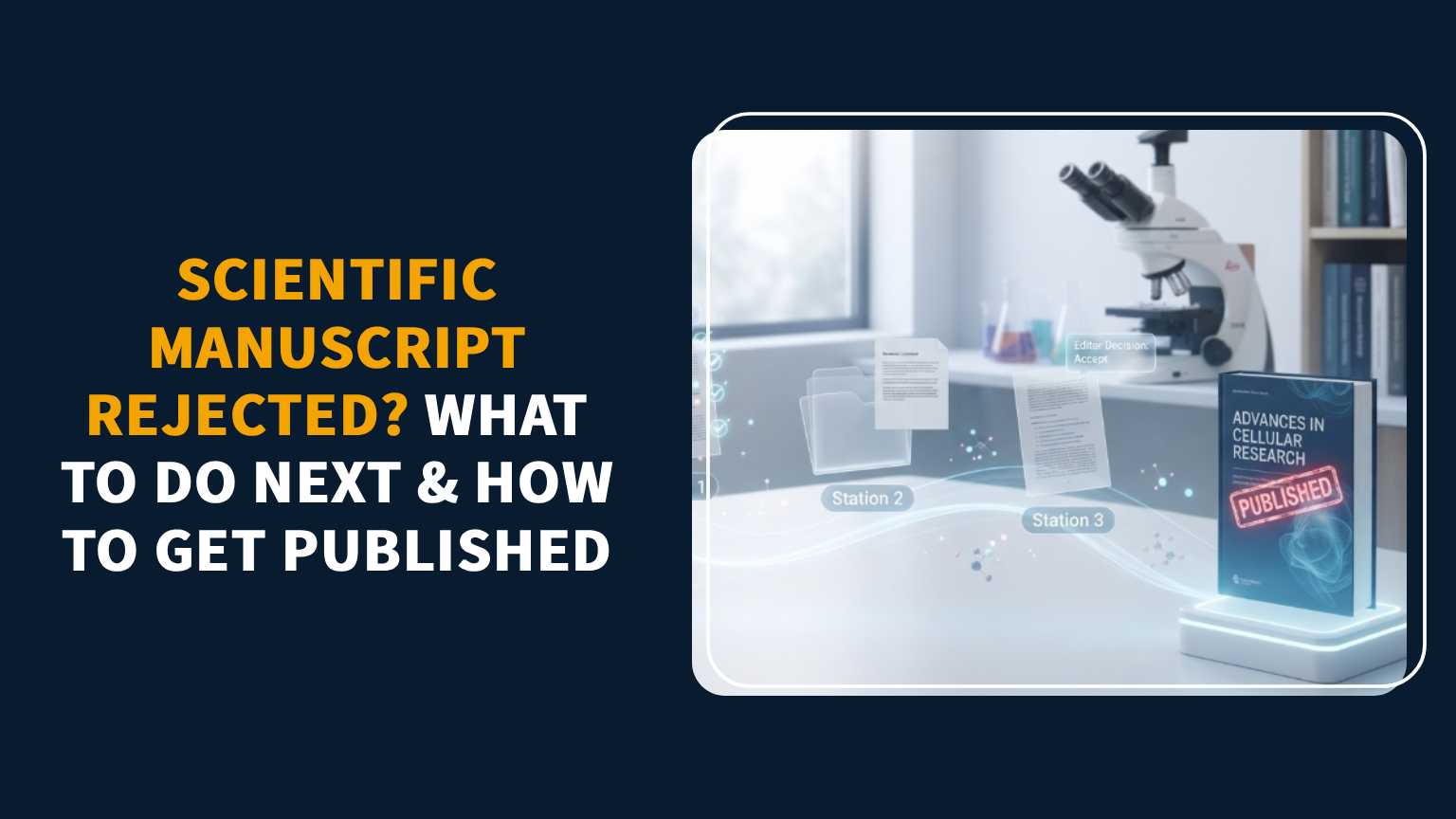
It feels like a personal setback when your scientific manuscript gets rejected, especially some months of consistent hard work like writing, revisions, and research. But, almost every individual faces rejections in life, as licensed researchers receive rejection letters in their entire career journey, making rejection a normal part of scientific publishing. Editors and reviewers reject papers for reasons that are frequently fixable, and most rejected manuscripts eventually find a home in a suitable journal once the right revisions are made.
If your scientific manuscript has been rejected, stop before you react, read the reviewer feedback carefully, and separate valid criticism from little stylistic notes. Revise your methodology, data presentation, and language once again, then either resubmit to a similar journal (if invited) or target a better-matched journal. Most rejected research papers are publishable with focused revision.
Why Do Scientific Manuscripts Get Rejected?
Manuscript rejection can happen at nearly every stage of academic publishing, and even highly cited researchers regularly receive rejection letters. Getting to know the underlying causes helps you approach the next submission with a clearer strategy instead of frustration.
Major Manuscript Rejection Reasons
Most manuscript rejection reasons fall into a handful of recurring categories:
- Scope mismatch — the study doesn’t align with the journal’s stated aims
- Weak novelty — the findings don’t add enough new value to the existing literature
- Methodological flaws — insufficient sample size, unclear controls, or unreplicable methods
- Poor data presentation — confusing figures, incomplete statistics, or unclear tables
- Language and structure problems — flow, grammar, or formatting problems that obscure the science
- Ethical or reporting gaps — missing consent statements, incomplete conflict-of-interest disclosures, or unclear data availability
Knowing these manuscript rejection reasons in advance allows authors to self-audit a paper before it ever reaches a reviewer’s desk.
Desk Rejection Vs. Rejection After Peer Review
Not every rejection that you face is equal. A desk rejection occurs before your paper is even delivered for a revision, while a rejection after peer review means subject-matter experts evaluate it before the editor makes a final decision.
| Aspect | Desk Rejection | Rejection After Peer Review |
|---|---|---|
| Timing | Days to 2 weeks | 6 weeks to several months |
| Who decides | Handling editor only | Editor, informed by reviewers |
| Common cause | Scope mismatch, poor fit, formatting issues | Methodology, data interpretation, novelty |
| Feedback detail | Minimal, often generic | Detailed, section-by-section |
| Next step | Choose a better-fit journal quickly | Revise based on specific comments |
| Resubmission odds | High, if journal choice improves | Moderate to high, if concerns are addressed |
Journal Editor Decision — How Editors Evaluate Submissions
The journal editor decision rarely depends on one factor. Editors consider the suggestions of the reviewer while also considering the journal’s editorial priorities, special error themes, and the entire fit with the readership. A paper can receive positive reviewer comments and still be rejected if the editor feels it doesn’t match journal audience criteria. That’s the reason why a detailed learning regarding the editorial method, not just the reviewer feedback, matters whenever you decide your next move.
What is a Rejection Letter Called?
A rejection letter contains more information than it first appears to. Learning to read it properly is often the difference between a wasted resubmission and a successful one.
Reading Between the Lines of Peer Review Comments
Peer review comments are usually written in academic shorthand, and authors sometimes misread constructive criticism as outright dismissal. Look for patterns across reviewers: if two independent reviewers raise a similar concern, treat it as a priority fix instead of making it a matter of opinion. Comments about “limited generalizability” or “insufficient controls” are rarely fatal, they’re usually asking for a particular, addressable revision.
Types of Rejection (Reject-and-Resubmit Vs. Outright Reject)
Editors typically issue one of two types of rejection. Wondering what a reject-and-resubmit plan shows? It shows you that the editor looks at your work progress, and is open to a substantially revised version as the new submission. Outright rejection is usually defined as a paper that is not a match for that journal by any means, despite the quality of the revision. Getting the right information on which category your letter falls into, shapes whether you revise-and-return or start fresh elsewhere.
What to Do Immediately After a Manuscript Rejection
The actions you take during the beginning of initial days after knowing that your scientific manuscript was rejected often shows how fast, and successfully you can move toward publication elsewhere.
Step 1 – Take Time Before Reacting Emotionally
You should give yourself 24–48 hours before you reply to reviewers or plan for revisions. Your instant reaction, especially with a rebuttal written out of frustration, rarely helps, and can harm your standing with an editor if you do the resubmission.
Step 2 – Analyze Peer Review Comments Objectively
Wait until the initial disappointment settles, read the peer review comments once again carefully. You need to create a simple chart, in which you mention each comment, whether it’s major or minor, and your planned response. This changes vague feedback into a concrete action list.
Step 3 – Decide Between Resubmission and a New Journal
It is not required for every rejected paper to go back to the same journal. If the editor explicitly invites a revised resubmission, that’s generally the correct way. If the rejection was outright, or scope-related, a rejected research paper is often served well by a fresh, better-matched journal.
Step 4 – Seek a Second Opinion from Co-authors or Mentors
You need to take this step of sharing the reviewer comments with co-authors or a mentor, whom you’ve faith in, before you make a deal regarding a revision plan. A second, less emotionally invested viewpoint often spots blind spots and helps prioritize which criticisms genuinely need addressing.
How to Revise a Rejected Research Paper
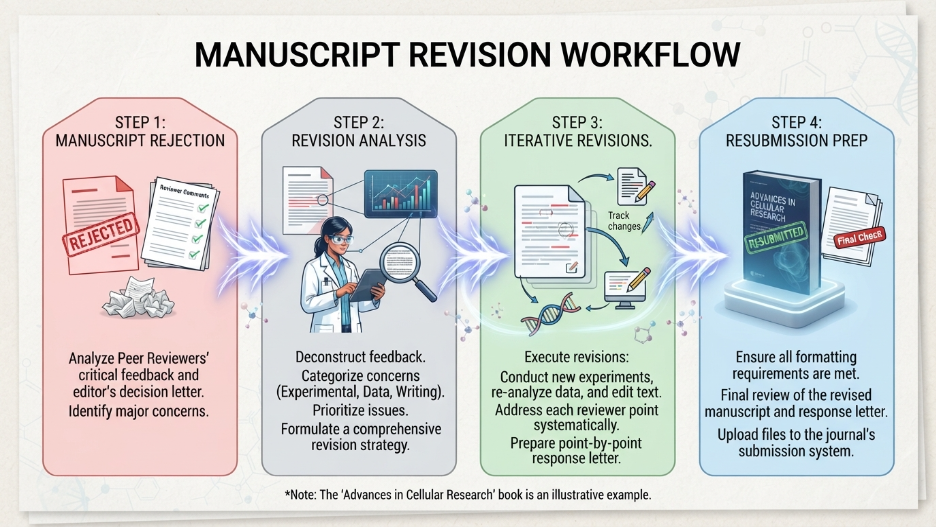
In such cases, where your scientific manuscript has been rejected and the decision consists of exclusive reviewer feedback, revising a rejected research paper than becomes a difficult task rather than a piece of cake, it is not a simple editing task. Treat the revision as a project with a clear checklist and a plan for resolving a reviewer’s concern.
Addressing Reviewer Concerns Point-by-Point
Create a response document that mentions every reviewer comment with the exact change you made (or your reasoning if you disagree). This document becomes the backbone of your rebuttal letter and indicates rigor to the next set of reviewers.
Strengthening Methodology and Data Presentation
If reviewers flagged methodological gaps, this is the section to prioritize. Evaluate the size of the sample, add any leftover statistical analyses, and clarify any assumption. Design the figures again, and tables so outcomes are unambiguous at a glance. Reviewers frequently reject papers not because the information is weak but because the findings are presented unclearly. Clear figures and tables make your outcomes easier to interpret.
Improving Language, Structure, and Formatting
This is one of the most essential steps of your revision process, grammar, and structural errors are the easiest errors to correct in your manuscript, yet they are usually the biggest reason for your continuous rejection that you face. Tighten your abstract, ensure consistent terminology overall, and implement the target journal’s formatting guide exactly, consisting of citation style and figure specifications.
For a deeper walkthrough of structuring reviewer responses, read our guide on how pre-submission peer review increases journal acceptance.
How to Resubmit a Rejected Manuscript
Once revisions are complete, the resubmission process deserves careful attention. Rushing this stage can undermine the value of a strong revision.
Resubmitting to the Same Journal
If invited, resubmission to the same journal usually means addressing the original reviewers directly. Keep your response document organized by reviewer and comment number so editors can verify each concern was handled.
Choosing a New Target Journal
When starting fresh, reformat the manuscript to match the new journal’s author guidelines, adjust the reference style, and revisit your cover letter to reflect why this particular journal is the right fit for the work.
Preparing a Fresh Cover Letter (and Rebuttal, if Applicable)
A good cover letter briefly describes the paper’s contribution and, where the right, notes prior review history without dwelling on it. If you’re returning to the similar journal, combine it with a detailed rebuttal letter. Our rebuttal letter guide breaks down how to structure this document efficiently.
When Should You Seek Professional Help With Your Manuscript
Get your work recognized on global research platforms with our expert guidance TODAY!
Not every revision has to be done entirely alone, and knowing when to bring in outside support can speed up the path to publication.
Some Obstacles Authors Face During Revision
Early-career researchers and non-native English speakers often face greater difficulties with translating difficult reviewer feedback into simple language changes, restructuring the sections completely with making it scientifically correct, or formatting a manuscript accurately for a new journal’s submission system.
When to Consider Scientific Manuscript Editing Services
If you struggle on polishing the language, technical restructuring, or formatting requirements after various checks, it may be time to bring in outside expertise. Numerous researchers turn to licensed scientific manuscript editing services at this stage, particularly when English isn’t their first language or when a tight resubmission deadline leaves little room for the rechecks. These services typically include formatting compliance, language refinement, and sometimes methodological clarity verification, without changing the substance of the research itself.
Choosing the Right Journal for Resubmission
Journal selection is one of the most overlooked factors in having your scientific manuscript rejected a second time, often for reasons that have nothing to do with the science itself.
Matching Journal Scope and Aim
Read the journal’s aims and scope page closely and compare it against your paper’s core contribution. A well-written paper submitted to the wrong journal is still likely to be rejected.
Checking Impact Factor and Turnaround Time
Balance ambition with realism. Targeting journals slightly below your first-choice journal’s impact factor, while analyzing published turnaround times, can ease your way to successful scientific paper publication.
Avoiding Predatory Journals
Be cautious of journals promising unusually quick acceptance or charging high fees with minor editorial scrutiny. Cross-check any unfamiliar journal against your institution’s library resources or the Directory of Open Access Journals before submitting. Look at our journal selection guide for a more detailed evaluation checklist.
Mistakes Authors Make After Rejection
- Resubmitting without making any real changes
- Ignoring or dismissing minor reviewer comments
- Choosing a mismatched or predatory journal
- Rushing the resubmission without proofreading
- Losing motivation and delaying revision indefinitely
Tips to Increase Your Chances of Getting Published
- Fix every reviewer comment, including minor ones, in the response document you made.
- Have a colleague outside your current field read the revised draft for clarification.
- Double-check formatting against the new journal’s author guidelines before submission
- Set a realistic timeline, most revisions often take longer than expected.
- Track your manuscript resubmission history so you don’t repeat the same journal-fit errors.
Conclusion
A rejected research paper is rarely the end of the road. With an objective read of the reviewer feedback, an innovative revision strategy, and a well-matched next journal, multiple papers are eventually published successfully. Take rejection as part of the publication method instead of a final judgment on your research.
Frequently Asked Questions
1. Can a rejected manuscript be published in another journal?
Yes. All the rejected manuscripts are generally submitted and revised to a completely new, better-matched journal, and multiple of them go on to be published successfully after handling reviewer feedback.
2. How long does it take to resubmit a rejected manuscript?
Timelines vary, but the manuscript resubmission can take anywhere from a few weeks to some months, depending on how broad the required revisions are and how fast co-authors reply.
3. Does manuscript rejection affect future submissions to the same journal?
Generally no. Editors evaluate each submission on its own merits, and a well-revised paper is often welcomed back, especially if you receive resubmit revision.
4. What makes a major revision request different from a rejection?
A major revision request is defined if the editor sees a publishable path and wants specific changes before reconsidering, while a rejection means the paper won’t be reconsidered in its current or resubmitted form at that journal.
5. How many journals should I try before considering the manuscript unpublishable?
There’s no fixed figure, but after three or four well-matched attempts with standardized, addressed revisions, it’s worth reassessing the paper’s core framing with a mentor or editing expert instead of the target journal.
For all-inclusive guidance on ethical resubmission practices, refer to the Committee on Publication Ethics (COPE) guidelines on manuscript resubmission, and rejection.