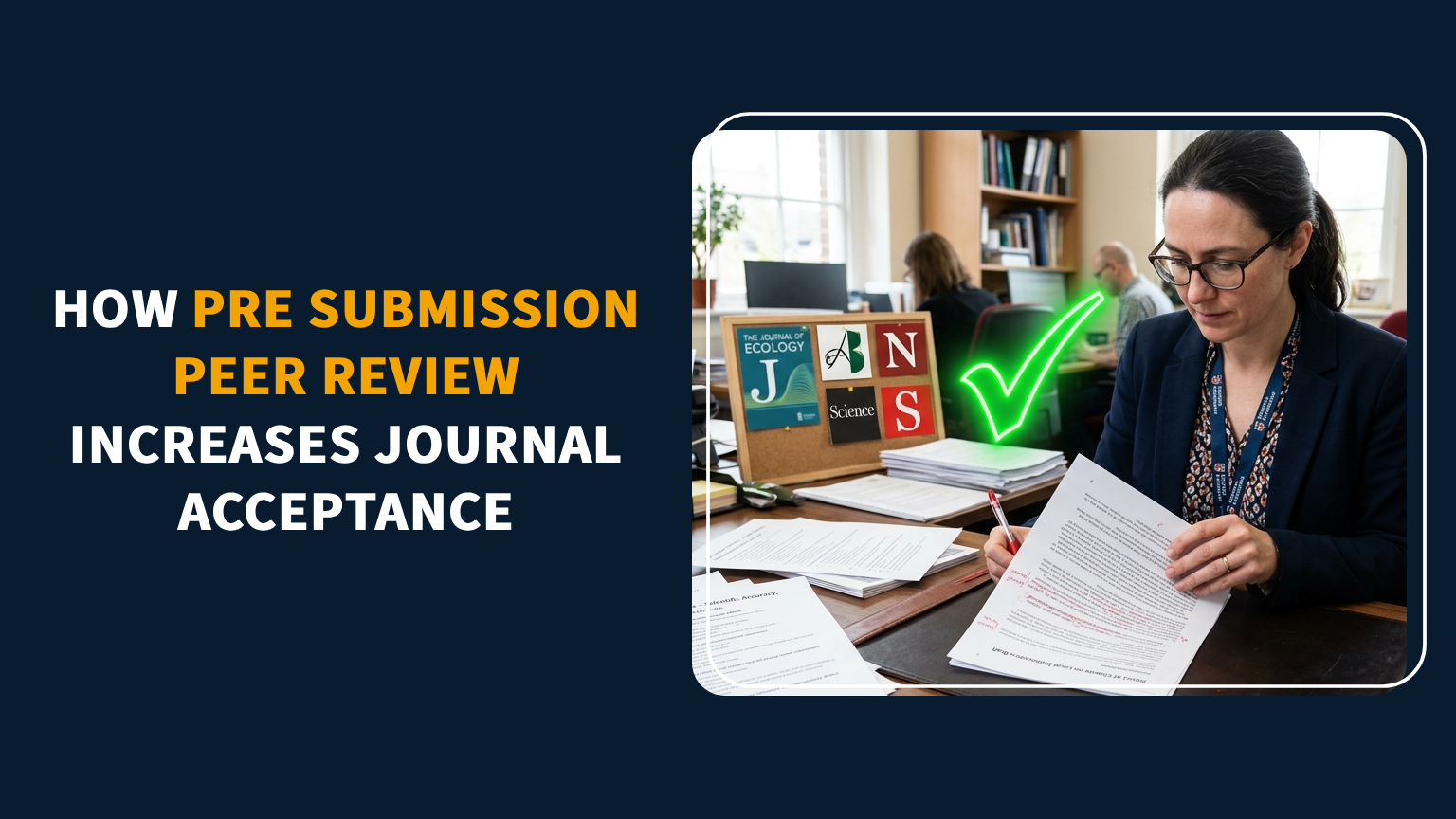
Most researchers pour months, sometimes years, into a single paper. Every argument is crafted carefully. Every dataset is verified twice. Every reference is formatted by hand.
And then the rejection email arrives. What makes this painful is not just the wait? It is the realization that the issues flagged by the editor, gaps in methodology, an outdated literature review, a mismatched journal scope, were all fixable. They just needed to be caught earlier.
That is precisely what pre submission peer review is designed to do.
What Is Pre Submission Peer Review?
In simple terms, pre submission peer review is an independent, expert-led evaluation of your manuscript before it reaches a journal’s editorial desk. A qualified reviewer, or a specialist team, reads your work and assesses it for scientific rigour, structural clarity, methodological soundness, and alignment with your target journal’s scope.
Think of it as a dress rehearsal before opening night. Rather than waiting for an editor to find the weak points, you get honest, constructive feedback from people who understand what reviewers and editors actually look for. As a result, you fix the problems before they cost you a rejection.
According to the Committee on Publication Ethics (COPE), a large proportion of manuscript rejections stem from issues that authors could have identified before submission, including weak study design, inadequate literature positioning, and poor journal fit. These are not small oversights. In fact, they are the exact reasons manuscripts land in the rejection pile on day one.
Why the Journal Acceptance Process Is Harder Than Most Researchers Expect
The journal acceptance process is, frankly, brutal.
High-impact journals indexed in Web of Science and Scopus regularly reject between 70 and 90 percent of all submissions. Even mid-tier journals with broader scopes turn away the majority of manuscripts they receive.
Rejections happen for a wide range of reasons: scope mismatch, formatting errors, unclear abstracts, insufficient methodology detail, weak engagement with recent literature, and poor language quality. Some of these are fixable in an afternoon. Others demand weeks of restructuring.
The real problem, however, is timing. Most authors discover these issues only after rejection. By that point, weeks or months have already slipped away, and the manuscript needs to be reworked before it can go anywhere else.
Pre submission peer review changes that dynamic entirely. Instead of learning what went wrong after the fact, you find out before submission, while there is still time to act on it without penalty.
How Peer Review Improves Research Quality
The importance of peer review in research is well documented. Formal peer review systems have formed the backbone of academic publishing for over three centuries, with structured review processes tracing back to the Royal Society of London in the 1660s.
What is less often discussed, however, is how pre submission review specifically improves research quality in ways that post-submission review simply cannot match.
Early Detection of Errors and Gaps
A pre submission reviewer reads your work with completely fresh eyes. Consequently, they catch logical inconsistencies, citation gaps, and methodological weaknesses that you, as the author, may no longer notice after months of close work with the material.
Research published in the journal Learned Publishing found that manuscripts which underwent informal pre submission review had significantly higher acceptance rates at their first target journal compared to those submitted without any pre-review process.
Sharper Argument and Clearer Contribution
Strong research alone does not guarantee publication. The way findings are presented matters just as much as the findings themselves. Moreover, a pre submission reviewer helps tighten the argument, clarify the conclusions, and ensure the manuscript’s contribution to the field is stated with precision rather than left for the reader to infer.
Smarter Journal Targeting
One of the most underrated benefits of pre submission peer review is journal fit assessment. An experienced reviewer understands the academic publishing landscape. They can quickly identify whether a manuscript is too specialized for a broad journal or too general for a niche one. That kind of guidance prevents the common and costly mistake of submitting to the wrong journal entirely.
The Tangible Benefits of Peer Review Before Submission
Rather than speaking in general terms, here is what pre submission review specifically delivers:
- Reduced rejection risk: Problems are identified and addressed before editors see them.
- Faster publication timeline: Fewer revision cycles after submission mean a quicker path to acceptance.
- Greater confidence at submission: You submit knowing your manuscript has been independently validated against journal standards.
- Stronger performance in formal peer review: When your manuscript reaches the journal’s own reviewers, weak points have already been resolved.
- Better-informed responses to reviewer comments: If reviewers do raise concerns, your pre submission preparation gives you a solid foundation from which to respond.
These outcomes are not theoretical. They are consistently reported by researchers who use professional pre submission support as part of their publication process.
How to Prepare a Manuscript for Journal Submission the Right Way?
Understanding how to prepare a manuscript for journal submission is a skill most academic training programs cover only briefly. In practice, thorough preparation involves several distinct stages.
Step 1: Choose Your Target Journal Before Writing the Abstract
Most researchers write first and select a journal later. That approach is, unfortunately, backwards. A journal’s scope, formatting requirements, citation style, and intended audience should shape how the research is framed from the very beginning. So before writing a single line of the abstract, read the journal’s aims and scope, study three to five recent articles, and understand what the editors genuinely value.
Step 2: Conduct an Honest Self-Review
Before anyone else reads the manuscript, assess it critically yourself. Read it as though you are a reviewer encountering it for the first time. Ask whether the methodology is described with enough detail for reproducibility, whether the literature review reflects genuinely current scholarship, and whether the conclusions follow logically and directly from the data.
Step 3: Engage a Pre Submission Peer Review Service
This is the step most researchers skip, and it is also the one that tends to make the biggest difference. A professional pre-submission peer review service connects your manuscript with qualified reviewers who evaluate it against journal standards before submission.
At Harvard Publication Hub, this process covers scientific rigour, argument structure, methodology transparency, journal fit, language quality, and formatting compliance. The aim is straightforward: to ensure your manuscript is genuinely ready before it reaches an editor’s desk.
Get your work recognized on global research platforms with our expert guidance TODAY!
Step 4: Revise Thoroughly and Without Shortcuts
Feedback from pre submission review is valuable only when acted upon fully. Address every point raised, not just the easier suggestions. The harder feedback is usually where the most significant improvements happen.
Step 5: Proofread for Language and Formatting
Once content revisions are complete, shift focus to language. Grammatical errors, awkward phrasing, and inconsistencies in academic tone signal carelessness to editors. At this level of competition, professional editing is not optional. It is a strategic necessity.
Peer Review in Academic Publishing: A Practical Reality Check
Peer review in academic publishing is widely respected, but also widely misunderstood by early-career researchers. Many assume that if the research is solid, publication will follow naturally. That assumption significantly underestimates how much presentation, positioning, and process actually matter.
Editors at high-impact journals make initial decisions quickly, often within days of submission. A manuscript that does not immediately communicate its value, methodological credibility, and relevance to the journal’s readership rarely makes it to formal peer review. As a result, strong research gets rejected not because it is poor, but because it was not packaged effectively.
Pre submission peer review addresses that problem directly. It ensures that when your manuscript reaches an editor, it looks like the work of a researcher who understands the publishing process, not someone submitting a first draft and hoping for the best.
The Longer-Term Value of Pre Submission Review
Here is something many researchers overlook: pre submission peer review is not just about improving a single manuscript. Over time, it becomes a professional development tool.
Each round of pre submission feedback teaches something new. Writers learn to craft stronger abstracts, justify methodology more clearly, and communicate research contributions with greater precision. Furthermore, they develop a more accurate understanding of what editors look for, rather than relying on assumptions.
As a result, researchers who consistently use pre submission review tend to build stronger publication portfolios over time. They submit fewer times per paper, target better-matched journals with more confidence, and spend considerably less time in revision cycles.
Why Harvard Publication Hub Is the Right Partner for This
Harvard Publication Hub supports researchers across 99 countries and more than 100 academic disciplines. The team includes over 300 specialists with deep expertise in ISI Web of Science and Scopus-indexed publishing.
The pre submission service goes well beyond a basic proofreading pass. It is a structured, expert-led evaluation covering scientific rigour, argument clarity, methodology transparency, journal fit, language quality, and formatting compliance.
Researchers who arrive with strong content but weak presentation leave with both. Those whose work needs structural guidance receive the focused support needed to turn a promising manuscript into a publishable one.
For a comprehensive overview of how professional support works at every stage, from pre submission through to final acceptance, this detailed guide on how to increase journal acceptance rates covers the full picture.
Common Mistakes That Pre Submission Peer Review Prevents
To make this practical, here are the most frequent errors that pre submission review catches before they trigger a rejection:
- Submitting to a journal whose scope does not match the research area
- Relying on an outdated literature review that misses key recent publications
- Presenting conclusions that go beyond what the data actually supports
- Including a methodology section that lacks the detail required for reproducibility
- Using informal or imprecise language that reduces academic credibility
- Ignoring the journal’s specific formatting and citation style requirements
- Submitting an abstract that fails to clearly state the research gap, method, and contribution
Every one of these mistakes is preventable. Moreover, every one of them causes real delays that set researchers back by weeks or months.
Final Thoughts
Rejection does not always reflect the quality of the research. More often than not, it reflects the quality of the preparation.
Pre submission peer review closes that gap. It gives your manuscript the strongest possible chance of succeeding at the right journal, on the first attempt, without the demoralizing back and forth of avoidable revisions.
If you are preparing a manuscript and want expert feedback before it reaches an editor, Harvard Publication Hub is ready to help. The process is clear, the feedback is thorough, and the goal is always the same: getting strong research published where it belongs.
Good research deserves to be published. Make sure yours gets there.