
A professional and good rebuttal letter for journal submissions thanks the editor and reviewers, sums up your revisions, and answers every reviewer comment point-by-point with transparent references to the exact modifications made in your manuscript. Editors utilize this letter, not just your revised paper, to judge whether you’ve genuinely engaged with the peer review process or simply patched over the issues on paper.
Get this letter right, and you can turn a “major revision” decision into an acceptance. Get it wrong, vague, defensive, or incomplete, and even strong research can be rejected on resubmission simply because the editor wasn’t convinced you took the feedback seriously.
This exclusive guide walks you through what a rebuttal letter for journal editors should have, how to structure an engaging rebuttal letter for journal resubmission, and how to handle even the toughest reviewer feedback with grace.
What is a Rebuttal Letter?
A rebuttal letter is the formal document you submit alongside your revised manuscript, addressing every concern raised during review. It’s your opportunity to show the editor, in writing, exactly how each critique was handled, what changed as a result, and why any comment you didn’t act on was left as-is.
Think of it as a bridge between the reviewers’ original concerns and your final revised manuscript. Editors read this journal editor letter first, often before they even open your updated paper, which is exactly why a well-written rebuttal letter for journal resubmission carries so much weight in the final decision.
Rebuttal Letter vs Response to Reviewers
These two terms are frequently used interchangeably, and in most journals, they refer to the same core document. A response to reviewers focuses purely on answering critiques individually, while a rebuttal letter for journal editors typically also includes a brief opening note and a closing statement, making it a slightly more complete package overall.
Why Editors Pay Close Attention to Your Rebuttal Letter
Editors rarely re-read an entire manuscript line by line during resubmission. Instead, they scan your rebuttal letter first to judge whether reviewer concerns were taken seriously and addressed thoughtfully. A clear, respectful, well-organized letter often influences the final decision more than the manuscript edits themselves, because it signals how seriously you are engaged with the review process as a whole.
When Do You Need to Write a Rebuttal Letter?
Major Manuscript Revision Requests
When reviewers flag significant methodological, structural, or interpretive issues, a detailed rebuttal letter for journal resubmission is mandatory. Editors expect a thorough manuscript revision alongside a reviewer’s comments response that addresses each concern individually, with clear justification for every change made.
Minor Manuscript Revision Requests
Even for smaller requests, clarifying a figure, adding a missing citation, or fixing a typo, a short rebuttal letter confirming each fix keeps your resubmission moving without unnecessary back-and-forth with the editorial office.
Rejected Manuscripts with an Appeal Option
Some journals allow authors to formally appeal a rejection decision. In these cases, your letter has to do double duty: defending the strength of your work while directly and respectfully countering the stated reasons for rejection, ideally with new evidence or clarification.
Key Components of a Strong Rebuttal Letter
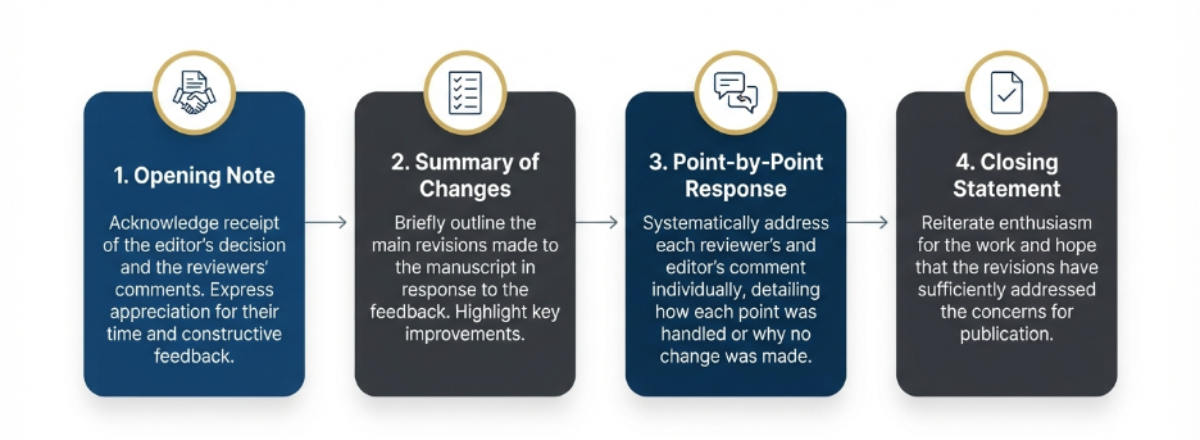
Opening / Thank-You Note to Editor and Reviewers
Start by thanking the editor and reviewers for their time and detailed feedback. This isn’t just courtesy, it sets a collaborative, professional tone before you begin your reviewer rebuttal in earnest.
Summary of Overall Changes
Briefly outline the major revisions made across the manuscript before looking into specifics. This gives editors a quick, digestible overview before they work through the detailed responses that follow.
Point-by-Point Response Section
This is the true core of the letter. Address every reviewer comment response individually, in the exact order the reviewer raised them, so nothing gets lost, skipped, or misread during a second review round.
Closing Statement
End with a short paragraph reaffirming your appreciation for the feedback and your confidence that the revisions have meaningfully strengthened the manuscript for publication.
How to Write a Rebuttal Letter
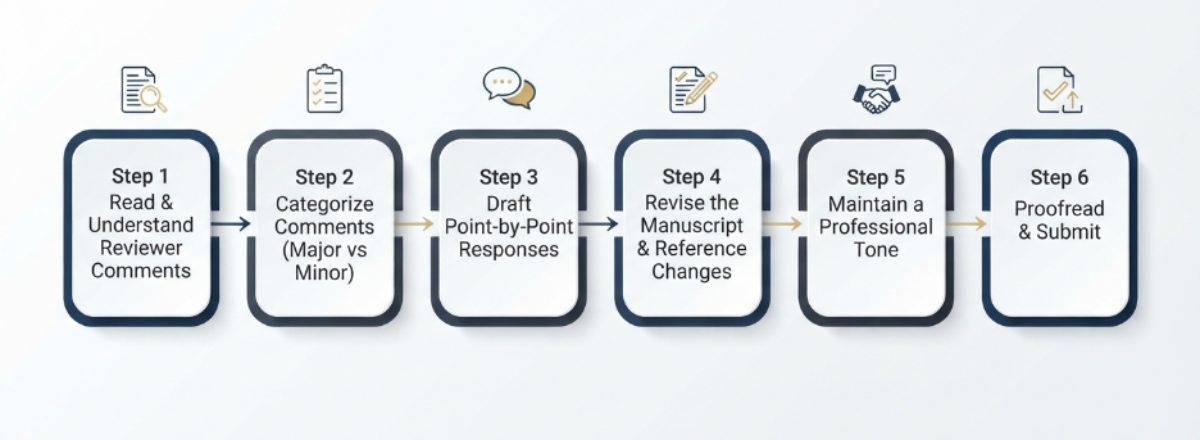
Step 1 – Read and Understand Every Reviewer Comment
Read all reviewer feedback in full before writing a single response. Misreading or skimming a comment early on can throw off your entire reviewer rebuttal and lead to answers that miss the actual concern being raised.
Step 2 – Categorize Comments (Major vs Minor)
Sort comments into major issues (requiring new analysis, additional data, or structural changes) and minor issues (wording, formatting, references). This simple sorting step helps you prioritize your time and tackle the hardest responses first while you’re still fresh.
Step 3 – Draft Point-by-Point Responses
For each comment, write a clear, direct answer explaining exactly what you changed and why, or, if you chose not to make a change, explain your reasoning with supporting evidence. Vague acknowledgments without specifics rarely satisfy reviewers on a second pass.
Step 4 – Highlight Corresponding Changes in the Manuscript
Reference specific page numbers, line numbers, or section headings so editors and reviewers can locate your edits instantly, without hunting through the entire revised document to confirm a change was actually made.
Step 5 – Maintain a Professional and Respectful Tone
Even when responding to harsh, dismissive, or seemingly unfair comments, keep your language calm and factual. Tone matters just as much as content, especially since editors read dozens of these letters every month and quickly notice defensiveness.
Step 6 – Proofread, Format, and Finalize Before Submission
Check for consistent formatting, correct reviewer numbering, and no leftover placeholder text before you hit submit. A polished, error-free rebuttal letter signals the same level of care you’ve put into the manuscript itself.
Get your work recognized on global research platforms with our expert guidance TODAY!
How to Deal with Difficult or Unfair Reviewer Comments Response
Disagreeing Politely and Professionally
You’re allowed to disagree with the reviewer comments response, just do it with evidence, not emotion. Explain your reasoning clearly and factually instead of dismissing the comment outright or responding defensively, which rarely works in your favor.
Backing Your Position with Evidence and Literature
Support any pushback with citations, data, or established methodology from your field. This approach turns a simple disagreement into a defensible, well-reasoned academic argument that editors are far more likely to respect and accept.
When to Seek Reviewer Comment Support
Some reviewer comments are technically dense, contradictory, or written in a tone that feels more personal than constructive, and responding well under these conditions isn’t easy, especially for early-career researchers still building confidence in the peer review process. In situations like this, many authors turn to expert reviewer comment support to help draft a measured, technically sound response without over-explaining, over-apologizing, or sounding defensive in the final letter.
Major Mistakes to Avoid in a Rebuttal Letter for a Journal
- Being defensive or emotional in your responses
- Ignoring minor comments because they seem unimportant
- Giving vague or generic responses instead of specifics
- Not referencing manuscript line numbers or page numbers for each change
- Missing submission deadlines after making extensive revisions
Avoiding these five major mistakes alone puts your resubmission ahead of a large share of the pile that editors see every single week.
Rebuttal Letter Template & Example
Sample Point-by-Point Response Format
A clean, consistent format or template makes your rebuttal letter easy for editors to skim, verify, and cross-check against the original reviewer comments without confusion.
Rebuttal Letter Template Table
| Reviewer Comment | Author Response | Manuscript Change/Location |
| “The sample size seems too small to support the conclusions.” | We agree and have expanded the sample size to strengthen statistical power. | See Section 3.2, Page 8 |
| “Figure 2 is unclear and needs better labeling.” | Figure 2 has been redesigned with clearer axis labels and a revised legend. | See Figure 2, Page 11 |
| “The discussion does not address contradictory findings in prior literature.” | We have added a paragraph addressing this literature directly. | See Section 5, Page 15 |
| “Methodology section lacks detail on data collection.” | We expanded the methodology section with a step-by-step description of the data collection protocol. | See Section 2.1, Page 6 |
Tips to Increase Acceptance Chances After Resubmission
A strong rebuttal letter for journal resubmission does more than answer complaints, it actively builds the editor’s confidence in your revised work. Keep your letter to the journal editor concise and avoid repeating the same explanation across multiple comments, even when several reviewers raised overlapping concerns. Match your rebuttal tone to the seriousness of each concern, a one-line acknowledgment is fine for a typo, but a major methodological critique deserves a fuller, evidence-backed explanation.
It also helps to resubmit promptly once your revisions are complete. Editors and reviewers notice when authors engage genuinely with feedback and move efficiently through the peer review process, rather than making only the minimum required changes and delaying the resubmission unnecessarily.
Final Words
A well-written rebuttal letter for journal resubmission can be the deciding factor between acceptance and another round of rejection. By understanding its core components, following a clear step-by-step process, and responding to reviewer comments with professionalism and solid evidence, you give your manuscript the strongest possible chance at final approval.
Treat your rebuttal letter with the same care as your manuscript itself. To your editor, it often reads as a direct reflection of your research integrity and your seriousness about publishing in their journal.
FAQs – Frequently Asked Questions
Is a rebuttal letter the same as a cover letter?
Absolutely not. A cover letter introduces your manuscript at initial submission, while a rebuttal letter responds to reviewer feedback during the revision stage.
How long should a rebuttal letter be?
Length varies by the number of comments, but most run two to six pages, long enough to address every point without unnecessary repetition.
What is the difference between a rebuttal letter and a response to reviewers?
They’re largely the same document; a rebuttal letter typically adds a brief opening and closing note around the point-by-point responses.
Can I disagree with a reviewer in my rebuttal letter?
Yes, as long as your disagreement is respectful and backed by evidence, literature, or sound methodological reasoning rather than opinion alone.
What happens if I ignore a reviewer’s comment?
Ignoring even minor comments can raise doubts about your thoroughness and may lead to further revision requests or an eventual rejection.
Should I number my responses to match the reviewer’s original comments?
Yes, matching numbering makes it easy for editors and reviewers to cross-check your responses against their original feedback line by line.