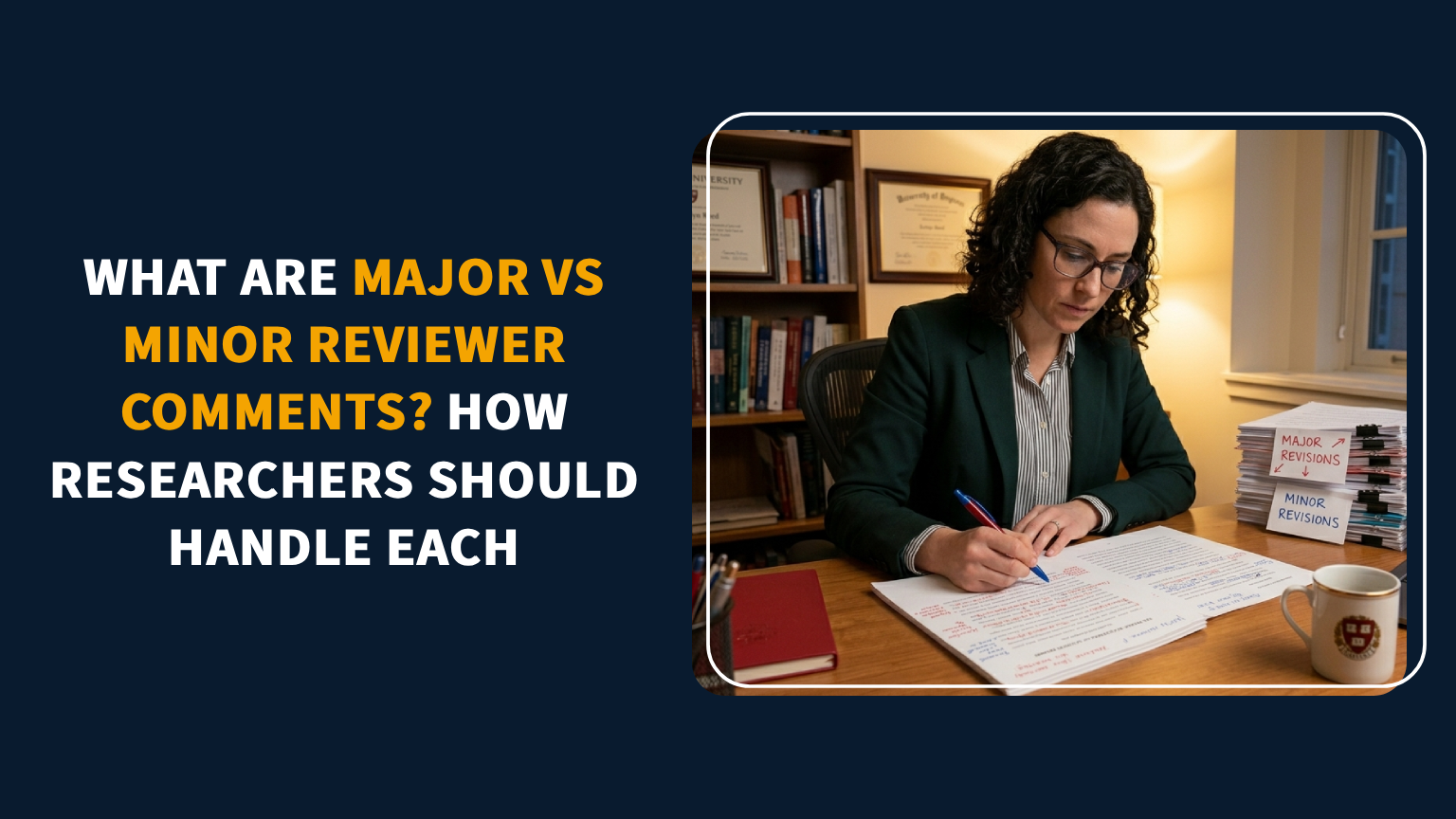
You submitted your manuscript. Weeks passed. Then the email arrived. Not a rejection. Not an acceptance. The dreaded in-between: “Your manuscript requires revisions before it can be considered for publication.”
Every researcher knows that feeling. Your heart sinks, then you open the reviewer comments document and discover it runs to three pages.
But here is the thing most researchers do not realize: not all reviewer comments carry the same weight. Understanding the difference between major vs minor reviewer comments is one of the most underrated skills in academic publishing. It saves time, reduces stress, and dramatically improves your chances of acceptance.
This guide breaks it all down clearly so you can stop guessing and start revising with confidence.
What Are Reviewer Comment Types?
When a journal sends your manuscript for peer review, each reviewer produces a structured list of feedback. These comments generally fall into two broad categories: major revisions and minor revisions.
Some journals also include a third category called editorial comments, which come directly from the editor and carry even more authority than peer reviewer feedback.
According to Elsevier’s author guide, peer review decisions typically follow one of four outcomes: accept, minor revision, major revision, or reject. Understanding where your manuscript lands, and what each comment type demands, determines your next move.
What Are Major Reviewer Comments?
Major comments address fundamental issues with your research. They question the core validity, methodology, or contribution of your work. These are not suggestions. They are requirements.
Common examples of major reviewer comments include:
- The sample size is insufficient to support the conclusions drawn
- The statistical analysis used is not appropriate for this study design
- The literature review ignores a significant body of recent work
- The research gap is unclear or poorly justified
- The discussion section overstates what the data actually shows
Major comments require substantial effort. You may need to re-run analyses, collect additional data, rewrite entire sections, or in some cases, reframe the core argument of your paper.
This is not a punishment. Reviewers who give major comments are doing you a favor. They are pointing out the gaps that could get your paper dismissed by readers, future reviewers, or cited incorrectly in other research.
Think of it as a free expert audit of your work. A painful but necessary one.
What Are Minor Reviewer Comments?
Minor comments deal with surface-level issues. They do not question your research design or conclusions. Instead, they improve clarity, consistency, and presentation.
Minor reviewer comments typically look like this:
- Please define the acronym on first use
- The figure caption on Figure 3 is unclear
- Some sentences in the introduction are too long and difficult to follow
- The references section has inconsistent formatting
- A few typographical errors appear throughout the manuscript
Minor comments are usually straightforward to address. Each one has a clear fix. Researchers sometimes underestimate minor comments, assuming they are easy enough to gloss over. That is a mistake.
Reviewers notice when minor comments go unaddressed. It signals carelessness. Always respond to every minor comment with equal professionalism.
Get your work recognized on global research platforms with our expert guidance TODAY!
How to Handle Major Revisions: A Strategic Approach
Knowing how to handle major revisions is what separates researchers who publish consistently from those who get stuck in revision loops.
Here is a practical approach:
1. Read everything before you respond to anything
Read all the reviewer comments from start to finish before you touch your manuscript. Some comments from Reviewer 1 may actually contradict comments from Reviewer 2. You need to spot those conflicts early and address them diplomatically.
2. Create a structured response document
Most journals expect a point-by-point response letter. Number each reviewer comment. Write your response beneath it. Quote the revised text where applicable. This document shows the editor you took the feedback seriously.
3. Prioritize comments by impact
Some major comments require methodological changes that will affect multiple sections of your paper. Address those first. Smaller major comments often fall into place once the bigger ones are resolved.
4. If you disagree, explain your position with evidence
You do not have to agree with every comment. Reviewers are not infallible. However, if you push back, you must do so politely and with supporting citations. A well-argued disagreement is far better than a silent non-compliance.
5. Do not rush the resubmission
Most journals give researchers 30 to 90 days for major revisions. Use that time. A rushed resubmission with half-addressed major comments almost always results in another round of revisions or an outright rejection.
If the volume of major revisions feels overwhelming, you do not have to navigate it alone. Harvard Publication Hub’s expert reviewer comment support service is designed specifically for researchers who want structured, professional guidance on turning difficult feedback into a successful resubmission.
How to Handle Minor Reviewer Comments
Minor comments are faster to resolve, but they still deserve a proper response.
Work through each comment one by one. Correct the issue in the manuscript. Note the change in your response letter with a reference to the page or line number where the revision appears.
If a minor comment asks you to clarify something, do not just rephrase it. Actually improve it. Add a sentence if necessary. Clarity is never wasted in academic writing.
One more thing: never group minor comments together with a vague response like “language has been improved throughout.” Reviewers see that as dismissive. Be specific.
Major vs Minor Reviewer Comments: At a Glance
Here is a quick comparison to keep in mind when you open that reviewer report:
Major Comments: Target methodology, data, analysis, research gaps, or core arguments. Require significant revisions. Usually need additional work, new citations, or supplementary data.
Minor Comments: Target language, formatting, clarity, typographic errors, or citation consistency. Require targeted corrections. Usually resolved within the existing text.
Both types matter. Both types are reviewed by the editor. And both types, if addressed well, can push your manuscript from revision to acceptance.
Common Mistakes Researchers Make with Reviewer Comments
Even experienced researchers fall into these traps. Avoid them.
- Skipping minor comments because they seem unimportant
- Providing one-line responses to major methodological concerns
- Resubmitting without a response letter
- Failing to highlight changes in the revised manuscript
- Taking reviewer criticism personally instead of professionally
- Missing the resubmission deadline without requesting an extension
The response letter is almost as important as the revised manuscript itself. Editors read it. A thorough, respectful, and well-structured response letter signals maturity as a researcher. It builds trust with the editorial team.
A Practical Journal Revision Guide for UAE Researchers
Researchers across the UAE, from Dubai to Abu Dhabi to Sharjah, face a specific challenge: many are publishing in high-impact international journals for the first time, often in English as a second language, within institutions that set demanding publication targets.
That context makes reviewer comments feel even more intimidating. But the peer review process is universal. A reviewer at a Scopus-indexed journal follows the same general logic whether your paper is submitted from London or Riyadh.
Here are a few things that help UAE-based researchers specifically:
- Request an extension if you need more time. Most journals grant it when asked professionally
- Work with a co-author or academic mentor to review your response letter before submission
- Use your institution’s research office if one exists. Many UAE universities now provide revision support
- Keep a revision log documenting every change made, even those not directly requested
For researchers who want a step-by-step framework for responding to peer feedback, our blog on how to Respond to Reviewer Comments covers the full response letter process, from tone to structure to common pitfalls.
When Should You Seek Professional Support?
Not every revision cycle needs external help. But there are situations where professional guidance genuinely changes the outcome.
Consider seeking support if:
- You have received major comments and are unsure how to address them without compromising your findings
- English is not your first language and you are concerned about how your response reads to reviewers
- You are working under a tight institutional deadline and need a faster turnaround
- Your manuscript has been rejected twice and you need an objective external review before the next submission
Harvard Publication Hub works with researchers at every stage of this process. With a team of 300+ subject-matter experts across disciplines from medicine to social sciences, the Hub has supported over 2,000 researchers in getting their work published in indexed journals.
Conclusion
Peer review is not a gate designed to keep researchers out. It is a process designed to make good research even better.
The distinction between major vs minor reviewer comments is not just administrative knowledge. It is a practical framework that helps you allocate time, manage energy, and communicate effectively with editorial teams.
Handle major comments with depth. Handle minor comments with care. Respond to everything professionally. And when the process feels bigger than your current capacity, remember that support is available.
Publication is not the finish line of your research. It is the starting point of its impact.