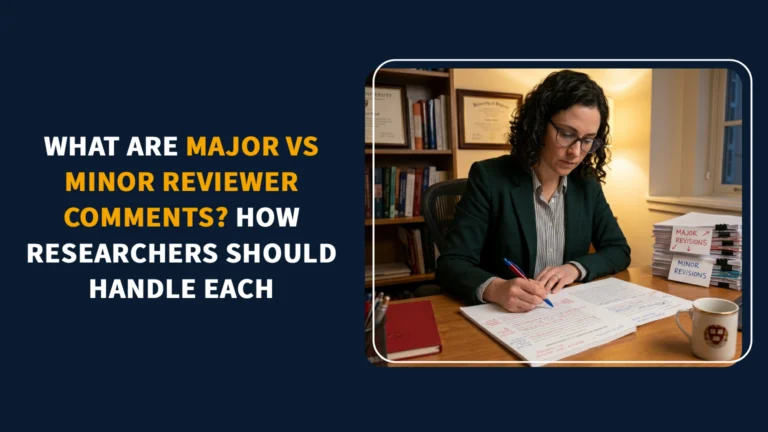
Peer review is the process by which independent experts in a field evaluate a manuscript’s quality, originality, and validity before a journal publishes it. An editor screens the submission, assigns qualified reviewers, collects their feedback, and then decides to accept, request revisions, or reject the paper based on that feedback.
What is Peer Review?
Peer review is the quality-control process academic journals use to evaluate research before publication. Independent experts, called peer reviewers, read a submitted manuscript and assess whether its methods are sound, its claims are supported by evidence, and its contribution to the field is genuine.
Purpose of Peer Review in Academic Publishing
The purpose of peer review is to catch errors, bias, and weak methodology before a study becomes part of the published scientific record. It also helps authors strengthen their work through expert feedback they wouldn’t otherwise receive.
If you want correct information on what is a peer-reviewed journal, let me inform you that a peer reviewed journal is one where every research article goes through this evaluation before publication, which is why peer-reviewed sources are treated as more reliable than non-reviewed ones in academic writing. This distinction matters most to early-career researchers choosing where to submit, since a journal’s peer review policy directly affects how their work will be perceived by tenure committees and grant reviewers.
Who Is Involved (Authors, Editors, Reviewers)
Three parties drive the process. The author submits the manuscript and responds to feedback. The editor manages the workflow, from initial screening to final decision. The reviewers, usually two or three per manuscript, evaluate the work and report back to the editor.
Editors are typically established researchers in the journal’s subject area, working either as staff or as volunteer academic editors. Reviewers are selected because their published work overlaps closely with the manuscript’s topic, which is what qualifies them to judge its methodology and claims.
How Does Peer Review Work? (Step-by-Step Process)
Peer review moves through five stages: an author submits a manuscript, an editor screens it for basic fit and quality, the editor assigns reviewers with relevant expertise, reviewers evaluate the work and submit feedback, and the editor makes a final decision to accept, request revisions, or reject.
Step 1 – Manuscript Submission
The author submits the completed manuscript through the journal’s online system, along with a cover letter explaining the study’s significance and confirming it meets the journal’s scope and formatting requirements.
Most journals now use a manuscript-tracking platform that timestamps every stage, which is worth knowing because it means you can usually see exactly where your submission sits in the pipeline rather than emailing an editor to ask.
Step 2 – Editorial Screening
Before a manuscript reaches reviewers, an editor checks that it fits the journal’s scope, meets basic formatting and ethical standards, and clears plagiarism screening. A large share of submissions are rejected at this stage without ever going to peer review.
This is a common trap first-time authors fall into: they treat rejection at screening as a verdict on their research quality, when it’s frequently a scope mismatch. A well-executed study submitted to the wrong journal gets desk-rejected regardless of its merit.
Step 3 – Reviewer Assignment
The editor identifies two or three researchers whose expertise matches the manuscript’s subject matter and invites them to review. Reviewers can decline due to conflicts of interest, workload, or lack of relevant expertise, so this step can take anywhere from a few days to several weeks.
Step 4 – Review and Feedback
Each reviewer reads the manuscript closely and writes a report assessing its methodology, originality, clarity, and contribution to the field. Reviewers typically recommend one of several outcomes and submit detailed comments to guide the author’s revisions.
Step 5 – Editorial Decision (Accept, Revise, or Reject)
The editor weighs all reviewer reports, resolves any disagreement between reviewers, and issues a final decision. Outright acceptance on the first round is rare; most published papers go through at least one round of revision first.
Peer Review Process at a Glance
| Stage | Who Acts | Typical Duration | Possible Outcome |
|---|---|---|---|
| Submission | Author | Same day | Manuscript enters system. |
| Editorial screening | Editor | 1–2 weeks | Desk reject or move forward. |
| Reviewer assignment | Editor | 1–3 weeks | Reviewers accept or decline. |
| Review and feedback | Reviewers | 4–8 weeks | Written reports submitted. |
| Editorial decision | Editor | 1–2 weeks | Accept, revise, or reject. |
Single-Blind vs. Double-Blind vs. Open Peer Review
Single-blind peer review hides the reviewers’ identities from the author. Double-blind peer review hides both the author’s and the reviewers’ identities from each other. Open peer review discloses both identities, and sometimes publishes the review reports alongside the paper.
What is Single-Blind Peer Review?
In single-blind peer review, reviewers know who the author is, but the author does not know who reviewed their work. This is the most common model in the sciences because it lets reviewers evaluate a study in the context of the author’s prior work and expertise.
The trade-off is that knowing the author’s identity can introduce bias, particularly favoring researchers from well-known institutions or established names in the field.
What Is Double-Blind Peer Review?
Double blind peer review removes identifying information from both sides. The author’s name, institution, and other identifying details are stripped from the manuscript before it reaches reviewers, and reviewers remain anonymous to the author throughout.
This model is intended to reduce bias based on institutional prestige, gender, or geography. It’s not airtight, since an author’s writing style, self-citations, or dataset can sometimes reveal their identity even with names removed, but it remains the preferred model in many social science and humanities journals.
What is Open Peer Review?
Open peer review discloses reviewer identities to authors, and in some journals, publishes the full review reports alongside the final paper. Advocates argue this increases accountability, since reviewers know their comments will be visible rather than anonymous.
A common concern with open review is that early-career reviewers may hesitate to give critical feedback to senior researchers when their name is attached. Journals that use open review generally address this by allowing reviewers to request anonymity on a case-by-case basis.
Peer Review Types Comparison
| Model | Author Sees Reviewer Identity | Reviewer Sees Author Identity | Common In |
|---|---|---|---|
| Single-blind | No. | Yes. | Most STEM journals |
| Double-blind | No. | No. | Social sciences, humanities |
| Open review | Yes. | Yes. | Emerging in medicine, some open-access journals |
No single model is universally superior. Each involves a trade-off between accountability, bias reduction, and reviewer willingness to give candid feedback, and journals choose based on their field’s norms and priorities.
What Peer Reviewers Are Looking For
Originality and Contribution to the Field
Reviewers check whether the study adds something new, whether that’s a novel finding, a new method, or a meaningful extension of existing work. A technically sound study that simply repeats prior findings without new insight is unlikely to be recommended for acceptance.
Methodology and Data Validity
This is usually where reviewers spend the most time. They evaluate whether the study design suits the research question, whether the sample size supports the conclusions drawn, and whether the statistical methods were applied correctly.
Clarity and Structure
A reviewer’s job gets harder when a manuscript is poorly organized or unclear, and that friction often shows up in the final recommendation even when the underlying research is solid. Clear writing isn’t cosmetic; it directly affects how accurately reviewers can evaluate your claims.
Ethical Compliance
Reviewers check for proper ethical approval, informed consent documentation where human subjects are involved, and disclosure of conflicts of interest. Journals that follow guidelines from bodies like COPE (the Committee on Publication Ethics) expect reviewers to flag any ethical concerns before a paper moves forward.
Peer Review Example – What Feedback Looks Like
Reviewer feedback typically combines specific, actionable comments with an overall assessment. Below is a peer review example showing the kind of comment a reviewer might leave on a methods section.
“The sample size (n=42) is adequate for the primary analysis, but the subgroup comparison in Section 3.2 is underpowered to detect the effect size claimed. Please either expand the subgroup sample or soften the claim in the discussion to reflect this limitation.”
Notice what this comment does: it identifies a specific problem, explains why it matters, and offers two concrete paths forward. Vague comments like “methodology needs improvement” without this kind of specificity are less useful to authors and are generally discouraged by journal reviewer guidelines.
Some Outcomes After Peer Review
Accept with Minor Revisions
The paper is fundamentally sound, and reviewers request small changes, such as clarifying a figure or adding a missing citation. This outcome usually means final publication is close.
Major Revisions Requested
Reviewers see potential in the paper but require substantial changes, such as additional analysis, a reworked methods section, or a more thorough discussion of limitations. A major revision decision is not a rejection. It’s an invitation to strengthen the paper and resubmit.
Rejection and Next Steps
If the study has fundamental flaws in design, doesn’t fit the journal’s scope, or the contribution is judged too incremental, the paper is rejected. Rejection at this stage still typically comes with reviewer comments, which authors can use to strengthen the manuscript before submitting elsewhere.
How to Prepare for and Respond to Peer Review
Preparing for peer review starts before submission. Read your target journal’s author guidelines closely, have a colleague outside your immediate research group read the draft, and make sure your methods section is detailed enough for a reviewer to evaluate without guessing.
When feedback arrives, respond to every point reviewers raise, even the ones you disagree with. A response letter that explains your reasoning, rather than ignoring a comment, gives editors confidence that you engaged seriously with the review. For researchers who want end-to-end support through this process, from initial submission strategy through final response letters, a peer review service can help manage the back-and-forth so nothing gets missed between rounds.
Getting Support with Reviewer Responses
Addressing reviewer comments well is its own skill, separate from writing the original manuscript. A strong response letter maps each comment to a specific change in the revised text, so editors and reviewers can verify the revision without re-reading the entire paper.
If you’re working through a difficult round of feedback, particularly conflicting comments from two reviewers, reviewer response support can help you draft a response that addresses both sets of concerns without contradicting yourself or overcommitting to changes that undermine your original findings.
Final Words
Peer review exists to catch weak methodology and strengthen good research before it reaches the published record, not to gatekeep for its own sake. Understanding each stage, from screening through editorial decision, makes the process far less intimidating for first-time authors and puts you in a better position to respond effectively when feedback arrives.
Frequently Asked Questions
How long does peer review take?
Most peer review processes take between two and six months from submission to final decision, though this varies widely by field and journal. Multiple revision rounds can extend the total timeline significantly.
Can I suggest my own reviewers?
Many journals allow authors to suggest potential reviewers during submission, though editors aren’t obligated to use them. Suggested reviewers should have no conflict of interest with the author or their institution.
What happens after peer review?
After a final acceptance decision, the manuscript moves to copyediting and typesetting before publication. If revisions were requested, the author resubmits, and the editor may send it back to the original reviewers for a final check.