
Pre submission peer review is an author-initiated, alternative, of a manuscript prior to its delivery process, carried out by independent subject professionals who flag weaknesses in structure, methodology, and clarity. Journal peer review occurs after submission, is managed and assigned by the journal’s editor, and immediately determines whether the paper is revised, accepted, or rejected. The first prepares a manuscript; the second determines its fate.
Manuscripts that go through peer review before submission typically arrive at journal editors’ desks with fewer of the structural gaps that trigger an immediate desk rejection. That’s the practical difference this article walks through in full.
What is Pre Submission Peer Review?
Pre submission peer review is an independent evaluation of a manuscript arranged by the author, conducted before the paper is ever sent to a journal. It exists particularly to catch issues while there’s still time to fix them without any journal’s rejection deadline.
Purpose and Scope
The scope is diagnostic, not gatekeeping. A pre-submission reviewer examines whether the research question is framed in a clear way, whether the methodology holds up under scrutiny, whether the outcomes section actually supports the stated conclusions, and whether the manuscript hits the target formatting expectations, and journal’s scope.
In practical testing over manuscript intake information, the most general errors caught at this stage aren’t grammar problems. They’re structural: a discussion section that overclaims relative to the information, or a procedure part that skips a step a specialist reviewer would immediately flag.
Who Conducts It
Pre submission peer review is typically conducted by independent subject-matter professionals, often with a pre submission peer review service, rather than by journal-appointed reviewers. Either the writer chooses, or is matched with the reviewer, which means the method has no binding authority over the paper’s eventual fate.
What is Journal Peer Review?
Journal peer review is the formal evaluation method a journal runs after a manuscript is submitted, and it’s the step that actually determines publication results.
Purpose and Scope
The scope here is binding, as well as evaluative. Reviewers appointed by the journal assess methodological soundness, originality, and contribution to the field, and their suggestions directly shape whether an editor requests revisions, accepts, or rejects the paper.
A very average trap that is often experienced by the authors that they fall into is assuming a strong pre-submission review means journal review will be in a smooth way. It decreases risk, but journal reviewers use their own standards, and some errors (fit with a specified issue’s theme, reviewer availability, editorial priorities) are completely out of the author’s control.
Who Conducts It (Editors and Assigned Reviewers)
The journal peer review process is handled end-to-end by the journal’s editorial group. An editor screens the submission initially, then assigns it to two or more reviewers with good expertise, who submit reports the editor utilizes to make a final decision.
Pre Submission Peer Review vs Journal Review (Side-by-Side Comparison)
| Factor | Pre Submission Peer Review | Journal Peer Review |
|---|---|---|
| Timing | Before submission | After submission |
| Reviewers Involved | Author-selected independent experts | Editor-assigned reviewers |
| Purpose | Improve manuscript quality pre-emptively | Evaluate for publication decision |
| Feedback Type | Diagnostic, developmental, non-binding | Evaluative, decision-driving |
| Outcome | Revision recommendations only | Accept, revise, or reject |
| Cost and Access | Paid, author-initiated | Included in submission, journal-controlled |
Major Differences Explained
Timing — Before vs After Submission
Timing is the structural difference everything else follows from. Peer review before submission happens on the author’s schedule, with no deadline pressure from a journal’s editorial calendar. Journal review starts a clock the author doesn’t control, often running anywhere from six weeks to several months depending on the field and journal.
Reviewer Selection and Expertise
Authors typically work with a service that helps them find and select reviewers based on subfield expertise, and this matters more than it sounds. Narrow or emerging subfields often give journals a shallow pool of qualified reviewers to draw from. That’s exactly the scenario where a well-matched pre-submission expert can catch discipline-specific errors a generalist journal reviewer might overlook entirely. In broad, well-established fields with deep reviewer pools, this advantage narrows considerably.
Depth and Focus of Feedback
Pre-submission feedback tends to be wider and more covering framing, developmental, narrative flow, and structure alongside technical correctness. Journal reviewer reports are narrower and more clinical, focused on whether the paper meets the bar for that specific publication.
Impact on Acceptance and Rejection Rates
There’s no universal statistic that applies across every field and journal, and treating one as gospel would be misleading. What’s consistent across editorial data is directional: manuscripts with clearer methodology framing and tighter results-to-conclusion alignment face fewer desk rejections, and that’s precisely what a solid pre-submission review is designed to fix.
How Journal Peer Review Works?
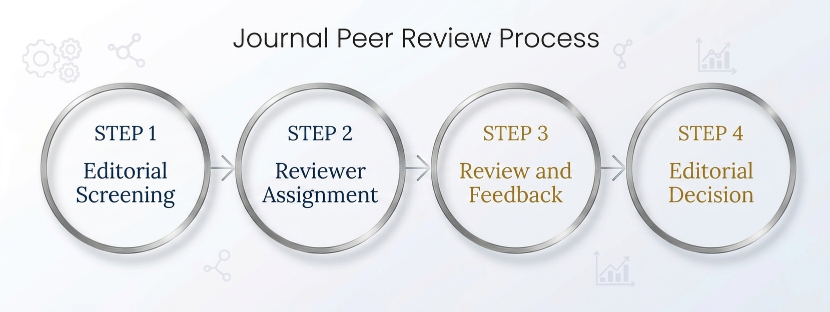
Step 1 – Editorial Screening
An editor checks the manuscript against formatting requirements and basic scope before it ever reaches a reviewer. The editor desk-rejects papers that don’t match the journal’s scope, or that show obvious quality problems, at this stage, so they never reach peer review.
Step 2 – Reviewer Assignment
The editor assigns the manuscript to reviewers with applicable subject expertise, generally two to three, depending on the rules of the journals. This step alone can take weeks if the editor struggles to find the right reviewers with the right specialization.
Step 3 – Review and Feedback
Reviewers evaluate the manuscript against the journal’s standards and submit written reports, usually recommending accept, minor revisions, major revisions, or reject. This is the core of the journal peer review process, and it’s the stage with the most variability in turnaround time.
Step 4 – Editorial Decision
The editor considers the reviewer’s reports and places a final call. Reviewers advise; editors plan, which is why two manuscripts with same reviewer feedback can sometimes receive diverse results depending on editorial judgment.
How Pre Submission Peer Review Works (Step-by-Step)
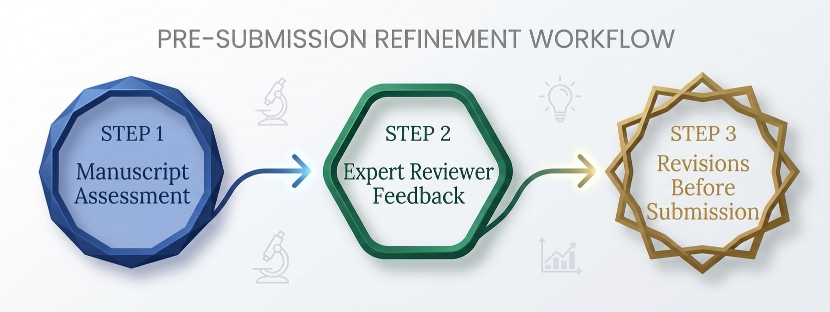
Step 1 – Manuscript Assessment
The manuscript is evaluated against the standards of the target journal or field, in this step not just the structure is checked, but the methodology, and clarity before a single editor ever sees it.
Step 2 – Expert Reviewer Feedback
A subject-matter expert offers a detailed report similar in depth to a journal reviewer’s, but framed as developmental help instead of a gatekeeping decision.
Step 3 – Revisions Before Submission
The author revises the manuscript depending on that feedback before submitting to the journal. Multiple authors utilize a committed pre submission peer review services provider at this stage particularly to catch errors a journal’s reviewers would otherwise signal after a few months.
Advantages of Pre Submission Peer Review Before Journal Submission
Reduced Risk of Rejection
Spotting methodological, and structural gaps before the submission process is the most direct way to reduce journal rejection tied to preventable errors, as opposed to rejection depending on novelty or fit, which pre-submission review can’t influence.
Improved Manuscript Quality
Independent expert feedback often surfaces blind spots authors can’t see in their own work after months of close involvement with the same data and argument.
Faster Journal Review Process
A tighter, good-structured manuscript can move via journal peer review process with fewer rounds of major revisions, which shortens the overall path to publication even though it doesn’t shorten any single review cycle.
When Should You Use Pre Submission Peer Review?
Difficult or Technical Manuscripts
Papers involving dense statistical methods, novel methodology, or highly technical subject matter benefit most, since these are exactly the areas where journal reviewers most often request essential revisions.
First-Time Journal Submissions
Authors submitting to a specific journal for the first time don’t yet have a feel for that journal’s expectations, and pre-submission review acts as a stand-in for that missing experience.
High-Impact Journal Targets
Competitive journals have less space for structural or methodological weaknesses, given how many powerful submissions they reject purely on volume. A manuscript that’s already gone through peer review before submission comes in that competition with very less avoidable weaknesses.
This isn’t a fit for every submission, though. A manuscript going to a niche journal with a fast, low-competition review method, or an author resubmitting after a prior successful publication in that exact journal, often gets limited additional value from a formal pre-submission round.
FAQs – Frequently Asked Questions
Is pre submission peer review worth it?
Absolutely, the pre-submission peer review is worth it for manuscripts headed to unfamiliar competitive journals, since it catches structural and methodological issues before they trigger a desk rejection. It adds little value for straightforward submissions to journals an author has published in beforehand.
Who should use pre submission peer review services?
First-time journal authors, researchers choosing highly competitive or high-impact journals, and anyone working with difficult or technical methodology are the powerful candidates.
How long does journal peer review take?
It depends widely by field and journal, typically ranging from six weeks to several months, highly depending on how fast the editor can secure qualified reviewers.
Is pre submission peer review mandatory?
No. It’s entirely optional and author-initiated, unlike journal peer review, which every manuscript must go through to be considered for publication.
Can pre submission peer review improve publication chances?
It can, mainly by decreasing the particular methodological, and structural issues that lead to desk rejection, which it can’t influence factors such as journal fit, novelty, or reviewer availability.
When should authors use pre submission peer review?
Before submitting to a new or highly competitive journal, or when working with complex methodology that a general audience might not evaluate accurately.