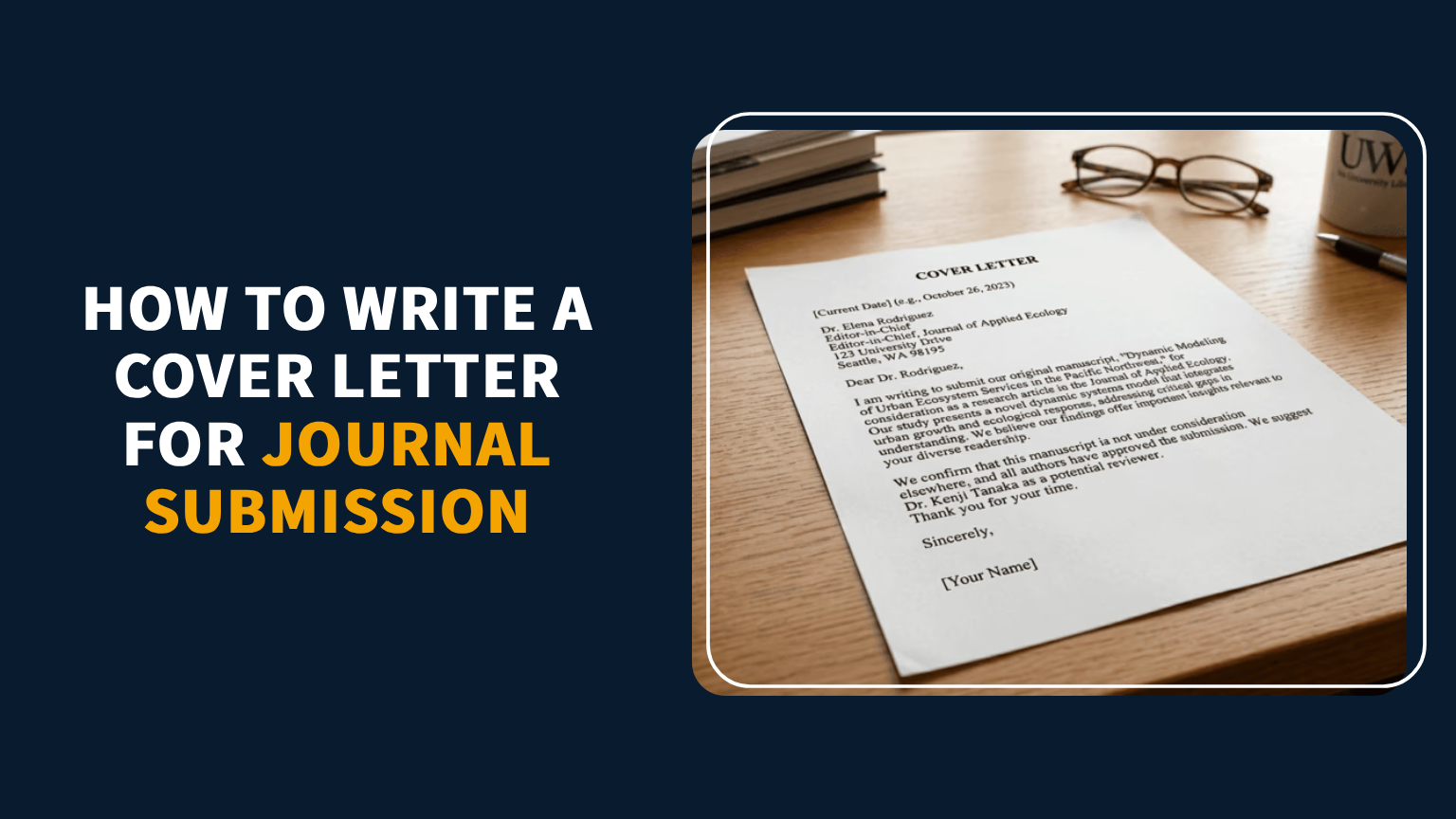
A cover letter for journal submission is a one-page letter addressed to a journal’s managing editor that represents your manuscript, states why your manuscript fits the journal’s criteria, and guarantees ethical compliance, and originality before peer review starts. A cover letter is delivered along with your manuscript, and its core task is to help the editor decide rapidly if your paper is worth sending out for a review.
A skillfully drafted cover letter for journal submission can enhance your manuscript’s first look and show that your research is a powerful fit for the target journal. Whether you’re delivering for the first time or getting the preparation done for another manuscript, getting the right information on what editors expect can assist you avoid general errors, and present your work more proficiently.
This comprehensive guide tells you how to write an efficient journal submission cover letter, what to add in it, which mistakes should be avoided to make, and how to use a practical template for your next submission.
What is a Cover Letter for Journal Submission?
Purpose of the Cover Letter
A cover letter for journal submission occurs to do one job greatly: satisfy an occupied editor, in a few seconds of him reading it, that your manuscript deserves a complete peer review. It isn’t a formality tacked onto the submission methodology. It’s your one direct, unfiltered chance to argue for your paper before anyone reads a single line of the manuscript itself.
Editors read hundreds of these letters a year. A letter that clearly states the research gap, the finding, and the fit with their journal gets read differently than one that simply says “please consider our manuscript for publication.”
Where It Fits in the Submission Process
The cover letter is uploaded or pasted alongside your manuscript during the online submission step, before peer review starts. It’s one of the first things a handling editor opens, often before the manuscript file itself.
That order matters. A weak letter can color how an editor approaches the manuscript that follows, even if the science underneath is solid.
What to Include in Your Journal Cover Letter
Editor’s Name and Journal Details
Address the letter to the handling editor by name whenever the journal lists one, check the journal’s editorial board page first. If no name is listed, “Dear Editor-in-Chief” is the safer default over a generic “To Whom It May Concern.”
Manuscript Title and Kind
State your manuscript’s exact title, word-for-word as it appears on your title page, along with its article type, original research, review, case report, or similar. A mismatched title between your letter and manuscript file is a small but real red flag for editorial staff.
Brief Summary of Importance and Novelty
In two to three sentences, state the problem your research addresses and what’s new about your findings. This isn’t the abstract rewritten, it’s the argument for why this specific finding matters to this specific journal’s readers.
A strong cover letter journal submission example opening line reads something like: “We report the first evidence linking [specific variable] to [specific outcome] in [specific population], addressing a gap noted in recent reviews of this field.” That’s specific, checkable, and gives the editor something concrete to evaluate.
Confirmation of Ethical Compliance and Authenticity
State plainly that the manuscript is original, unpublished, and not under review elsewhere. Where applicable, confirm ethical approval, informed consent, and funding disclosures. If you used generative AI tools for drafting, data analysis, or figure generation, disclose that here too, a growing number of major publishers now require this stated explicitly in the cover letter, not buried in the methods section.
If you’re unsure exactly what to write in a cover letter for journal submission regarding declarations, the safest approach is a short, direct sentence for each: originality, funding, ethics, and AI use, in that order, even when the answer to each is simply “none to declare.”
Suggested Reviewers (If Applicable)
A few journals request for suggested reviewers, and occasionally reviewers to exclude. If you need to request an exclusion, keep it professional, and factual, mention the cause (a recent collaboration, an institutional conflict, a documented prior dispute) without editorializing about the person. An exclusion request written as a grievance reads as unprofessional and can work against you.
How to Write a Cover Letter for Journal Submission Step by Step
Step 1 – Handle the Editor Accurately
Utilize the handling editor’s actual name and title where stated. Skip flattery (“your esteemed journal”) entirely, it reads as filler, not respect.
Step 2 – Introduce the Manuscript
Open with the manuscript title, article type, and one sentence on what it examines. Editors should know exactly what they’re holding within the first two lines.
Step 3 – Highlight the Manuscript’s Contribution
State the specific gap your paper fills and why your journal’s readership specifically will care. Avoid vague significance claims, “novel” and “groundbreaking” mean nothing without a concrete, checkable detail behind them.
Step 4 – Verify Compliance and Originality
Cover ethics, funding, originality, and AI-use declarations in precisely, straightforward statements. This part protects both you and the editorial office from any disputes in future.
Step 5 – Close Professionally
Thank the editor for giving their time and efforts, list your complete contact details as corresponding author, and sign off. Keep the closing to three or four lines, this isn’t the place to re-argue your case.
Cover Letter Template (Download-Ready)
[Date]
[Editor’s Name, Title]
[Journal Name]
Dear Dr. [Last Name],
We are pleased to submit our manuscript, “[Full Title],” an [article type] for
consideration in [Journal Name]. This study addresses [specific gap], and we
believe it will be of strong interest to your readership given [journal’s
specific scope or recent coverage].
[2–3 sentence summary: problem, method, key finding, and why it’s novel.]
We confirm this manuscript is original, has not been previously published, and
is not under review elsewhere. [Funding statement.] [Ethics/consent statement,
if applicable.] [AI-use disclosure, if applicable, or “No generative AI tools
were used in the preparation of this manuscript.”]
[Suggested/excluded reviewers, only if requested by the journal.]
Thank you for your time and consideration. Please direct correspondence to
the undersigned corresponding author.
Sincerely,
[Full Name, Affiliation, Email, ORCID iD]
Cover Letter Mistakes That Cause Desk Rejection
| Mistakes | Why it Hurts You | Quick Fix |
| Generic or copy-pasted letters | Signals the letter wasn’t customized for this journal | Name the journal and its scope explicitly in the opening line |
| Missing journal-specific details | Editor can’t see why this journal over any other | Reference the journal’s stated aims or a recent related article |
| Overselling or exaggerating findings | Damages credibility before peer review even starts | Replace superlatives with one specific, checkable detail |
| Ignoring journal formatting guidelines | Creates extra work for editorial staff, an easy reason to pass | Check the author guidelines’ cover letter requirements before writing |
Copy-Pasted or Generic Letters
Sending a letter that could go to any journal without editing it is the fastest way to signal a lack of genuine fit, and editors notice this pattern immediately.
Missing Journal-Specific Information
Failing to reference the journal’s scope or readership makes your submission feel like a mass mailing rather than a deliberate choice.
Overselling or Exaggerating Discoveries
Unsupported claims about significance invite doubt before a reviewer has even opened the manuscript document.
Avoiding Journal Formatting Instructions
Several journals set explicit word or page limits for cover letters. Ignoring a stated limit, even by a little margin, is an unforced error that’s fully avoidable.
Manuscript Submission Cover Letter vs Standard Cover Letter
A manuscript submission cover letter is not the same document as a standard job-application cover letter, despite the shared name. A standard cover letter sells a candidate’s career history and skills to a hiring manager. A journal cover letter sells a single piece of research to a subject-matter expert, using scientific specificity rather than personal narrative. Where a job cover letter often opens with enthusiasm and personality, a manuscript submission cover letter opens with the title, the gap, and the fit, personality has almost no role here.
Why a Strong Cover Letter Improves Your Submission Outcome
A good cover letter doesn’t assure approval, but it does influence whether your manuscript gets a fair first read instead of a fast pass. Editors handle a high volume of submissions, and a letter that makes the fit and contribution obvious decreases the friction standing between your manuscript and peer review.
For authors handling numerous journal targets, unusual formatting requirements, strict deadlines, or requirements, working with a journal submission service can assist handling the complete submission method, cover letter writing, formatting analyzing, and post-submission follow-up, so nothing falls through in the time of a high-stakes deadline.
It’s also worth being trustworthy about where a cover letter matters less. At journals such as Nature, which explicitly mention the letter is optional, time is often better spent tightening the manuscript’s discussion section than refining persuasive language; the editor may not weigh heavily either way. A powerful letter helps at journals that read it closely, it isn’t a universal lever at every venue.
Final Verdict
A cover letter for journal submission is a short, high-leverage document, one page, built around fit and contribution, not flattery or restated abstract text. Address the right editor, state your manuscript’s title and novelty plainly, confirm originality and ethical compliance including AI-use where relevant, and close without padding. Get those fundamentals right, and the letter does exactly what it’s meant to do: get your manuscript read fairly, on its own merits.
Frequently Asked Questions
Do all journals need a cover letter?
Absolutely not, requirements vary by publisher. Multiple peer-reviewed journals require one, some list it as optional, and a small number don’t request one at all, so it’s worth checking the particular journal’s author rules prior to the submission part.
How long should it be?
Various journal cover letters run 250–400 words, fitting comfortably on one page. If a journal mentions its own word or page limit, follow that exact figure rather than the general range.
Can I use the same cover letter for multiple journals?
At a minimum, update the journal name, explain why the manuscript fits the journal’s scope, and include any journal-specific declarations. A letter that clearly lacks customization is one of the quickest ways to signal a lack of genuine interest in that particular journal.