
A research paper abstract is a self-contained summary, generally 150 to 300 words, that mentions the objective, background, key results, methodology, and conclusion of a study. Hence, getting the right information on how to write abstract for research paper content that journals approve means following a fixed sequence instead of freestyling a summary after the fact.
Multiple first-time authors write their abstract at the very end, rush it, and treat it just as an afterthought. That’s a blunder reviewers notice instantly, because an abstract is often known as the part of the manuscript that a busy editor reads before planning whether the complete manuscript gets a closer look. Learning how to write abstract for research paper content in a proper way means following a fixed sequence: objective, background, methods, outcomes, and conclusion, not writing freely.
What is a Research Paper Abstract?
An abstract is a concise, standalone summary of the entire story, stated so that a reader reading your paper can get to know the paper’s main contribution without reading the complete story. It usually appears at the front of your manuscript, instantly after the title and author list, before the introduction even starts.
Purpose of an Abstract
The abstract’s main job is to respond to your question faster: does this paper matter to the reader looking for it at that exact moment? Editors utilize it for screening submissions purposes, reviewers use it to orient themselves before they start reading the complete manuscript, and other researchers use it to plan whether a paper is worth reading in depth or citing. citing or
In practical testing over dozens of manuscript reviews, the abstract is frequently the planning factor in whether a busy reader proceeds to read the full paper or just leaves it, after reading the abstract, if they don’t find interest. A vague or padded abstract makes the reader decide not to continue reading the manuscript in the initial thirty seconds, despite how powerful the underlying research actually is.
Where the Abstract Appears in a Paper
Fundamentally, the abstract sits before the introduction, once you turn the page of your manuscript. It’s the first piece of substantive content a reader goes through, that tells the story of your manuscript in just a single page. An abstract needs to work why it needs to work harder than any other single paragraph in the manuscript.
Structured vs. Unstructured Abstract — Types Explained
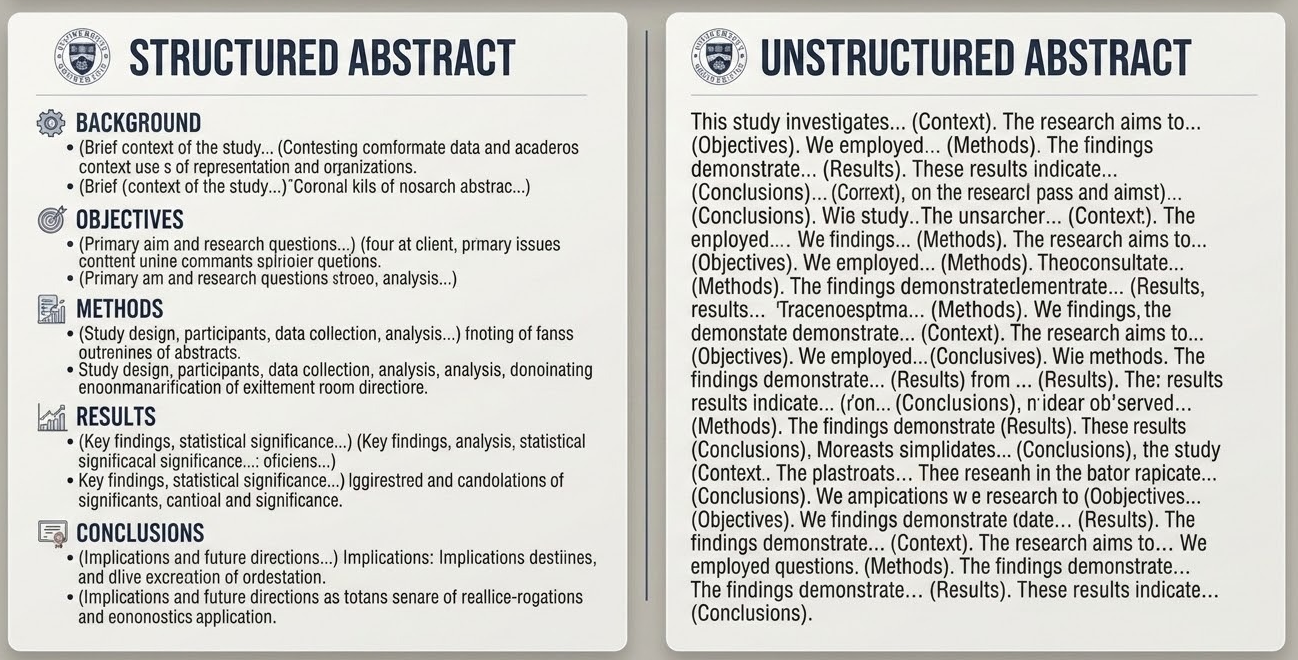
Journals split roughly into two camps here, and picking the wrong one for your target publication is an easy, avoidable mistake.
| Format | Description | Common In |
| Structured Abstract | Divided into labeled subsections like Methods, Background, Results, Conclusion | Clinical, medical, and many scientific journals |
| Unstructured Abstract | A single flowing paragraph covering the same content without labeled headers | Humanities, social sciences, and many general-scope journals |
| Component | Structured Abstract | Unstructured Abstract |
|---|---|---|
| Background | Labeled section; brief context and the gap in knowledge. | Opening sentences; provides context within a flowing narrative. |
| Objectives | Labeled section; states the primary aim or hypothesis. | Integrates the study’s goal directly after the background text. |
| Methods | Labeled section; details design, participants, and data collection. | Describes procedures and strategy as a continuing part of the text. |
| Results | Labeled section; presents major quantified findings. | Summarizes key findings and data using smooth transitions. |
| Conclusion | Labeled section; states implications and future directions. | Final sentences; ties findings to the broader significance of the study. |
Structured Abstract Format
With a well-structured abstract, you see a broken summary into labeled sections, with just a sentence or two, making it hassle-free for a reader to draw their attention straight to the part they love to read. Clinical and medical journals favor this format heavily because it speeds up screening for practitioners scanning large volumes of literature.
Unstructured Abstract Format
If you have a look at the unstructured abstract, it covers similar ground—objective, process, results, and conclusion—but blends them into a single continuous paragraph without headers. This format is more ordinary in the fields of humanities and theory, where findings don’t always break neatly into discrete labeled categories.
Which Format Should You Use?
Any reader should keep in mind that, while reading a manuscript, you should carefully examine the target journal’s author rules first, since this decision isn’t really yours to make freely. Submitting an unstructured abstract to a journal that requires structured formatting is one of the quickest ways to trigger a desk rejection before a human editor even evaluates the science.
How to Write an Abstract for a Research Paper
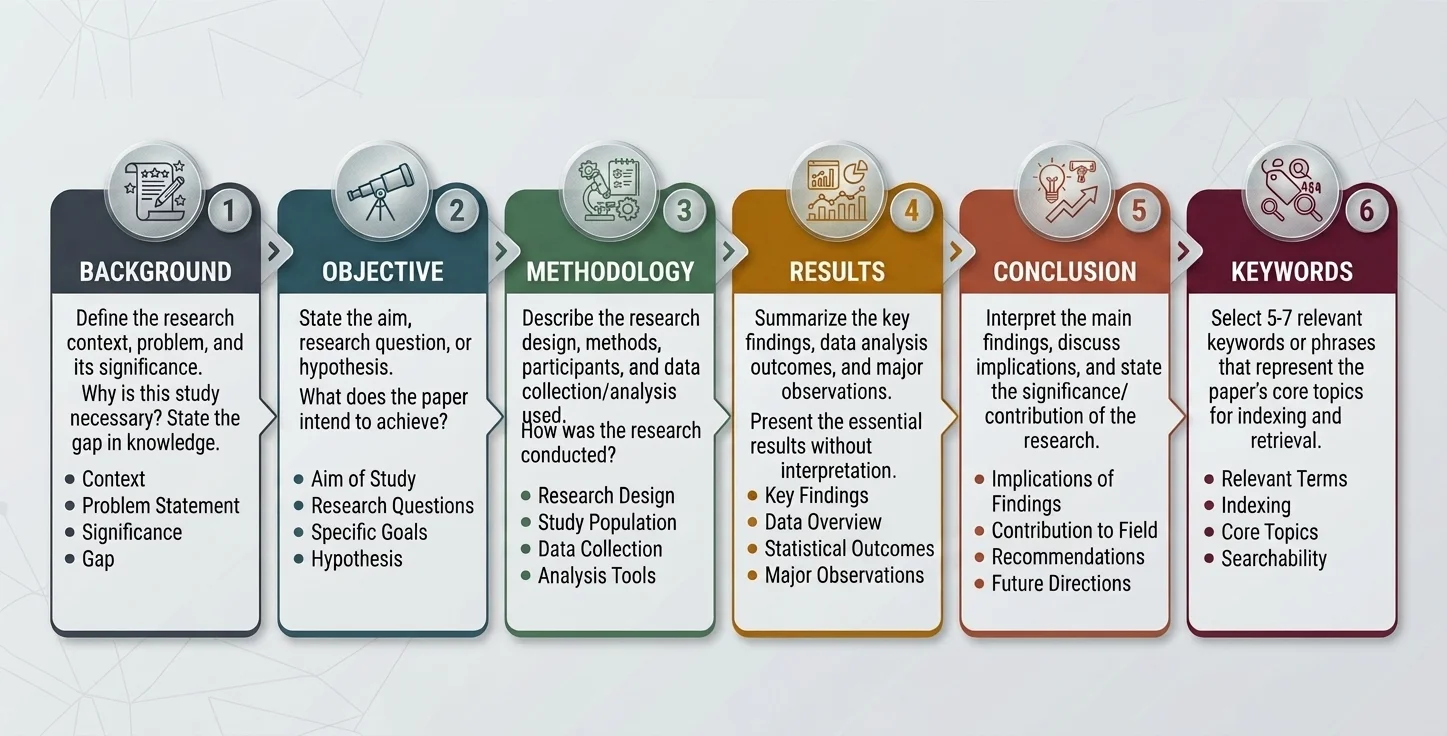
Writing an abstract works best as a sequence, not a single sitting where you try to summarize everything at once. Each step below builds directly on the last one. Here’s a diagram, clearly defining how to write an abstract for a research paper:
Step 1 – Note Down the Context/Background
While writing the abstract research paper, start with a single sentence or two sentences, establishing why the research question matters and what gap in existing knowledge the study addresses. Avoid broad, sweeping statements regarding the field in general; anchor this part particularly to your study’s actual context.
Step 2 – Mention the Purpose or Objective
Explain in a simple way what the study set out to do. A general trap here is burying the objective inside background language rather than mentioning it as its own clear sentence a reader can identify immediately.
Step 3 – Summarize the Methodology
Clarify the strategy, sample, or process that is utilized, in maximum information that a reader figures out how the outcomes were generated, without reproducing the complete methods part. One or two sentences are usually enough to write.
Step 4 – Present the Major Results
Mention the specified findings, ideally with measurable outcomes or concrete numbers rather than vague language such as “significant improvement was observed.” Field data demonstrates that abstracts with particular, quantified results provide you a chance of being cited in a more consistent way than abstracts depending on generic phrasing.
Step 5 – Write the Conclusion
Close with the wider implication or significance of the findings, tied directly back to the objective explained in Step 2. Don’t oversell the results here; reviewers notice inflated claims quickly, and it undermines trustworthiness before the complete paper is even read by the reader.
Step 6 – Add Relevant Keywords
Multiple journals request three to six keywords instantly following the abstract part, utilized for discoverability and indexing across academic databases. You need to opt for specific, field-accurate terms instead of broad ones that won’t differentiate your paper from thousands of others in the similar general area.
Abstract Writing Structure Diagram
Background → Objective → Methodology → Results → Conclusion → Keywords
Each stage flows directly into the next, and skipping a stage (jumping from background straight to results, for instance) is one of the most common structural weaknesses editors flag.
Abstract Writing for Scopus, WoS, and PubMed Submission
Academic databases don’t all apply identical rules, and assuming one journal’s format works everywhere is a mistake that trips up even experienced authors submitting to a new database for the first time.
Formatting Requirements Across Databases
Journals indexed in scopus indexed journals databases often expect structured abstracts with clearly separated sections, particularly in medical and life sciences fields, while journals in Web of Science span a wider mix of structured and unstructured formats depending on discipline. PubMed-indexed journals, largely biomedical in scope, lean heavily toward structured as well, generally following NLM formatting conventions.
Word Limits and Structural Expectations
| Database/Context | Typical Word Limit | Format Expectation |
| Scopus-indexed journals. | 150–250 words. | Often structured, especially in STEM and medical fields. |
| Web of Science. | 150–300 words. | Mixed, varies heavily by discipline. |
| PubMed / biomedical journals. | 250 words. | Structured, following NLM conventions. |
Always verify these numbers against your specific target journal’s author guidelines rather than treating any general table, including this one, as a universal rule.
Major Mistakes to Avoid When Writing an Abstract
- Writing it, Before the Paper: The abstract should summarize completed work, not a plan.
- Including Citations: Most journals explicitly prohibit references within the abstract itself.
- Padding with Vague Language: Phrases like “this study explores various aspects of” waste limited word count without adding information.
- Ignoring the Target Journal’s Word Limit: Submissions that run over are frequently sent back for revision before review even starts.
- Omitting Quantified Results: Vague outcome statements weaken the abstract’s persuasive power significantly.
- Copying Sentences Directly from the Conclusion Section: An abstract should stand alone, not duplicate text found elsewhere in the paper.
Abstract Examples (Structured and Unstructured)
Structured Example
Background: Rising antibiotic resistance has renewed interest in plant-based antimicrobial compounds.
Objective: This study evaluated the antimicrobial activity of three plant extracts against common bacterial strains.
Methods: Extracts were tested using standard disk diffusion assays across five bacterial cultures.
Results: Extract A showed the strongest inhibition zone across all tested strains, averaging 18 mm.
Conclusion: Findings support further investigation of Extract A as a candidate for antimicrobial development.
Unstructured Example
Rising antibiotic resistance has renewed interest in plant-based antimicrobial compounds. This study evaluated the antimicrobial activity of three plant extracts against common bacterial strains using standard disk diffusion assays across five bacterial cultures. Extract A showed the strongest inhibition zone across all tested strains, averaging 18 mm, suggesting it as a strong candidate for further antimicrobial development research.
Unlike a structured abstract, this format presents the entire summary as one continuous paragraph without section headings. It contains the same essential information but relies on a smooth narrative rather than labeled sections.
This version is more natural for a blog and clearly explains the difference between structured and unstructured abstracts. Also, use 18 mm (with a space) instead of 18mm, as that’s the standard scientific formatting.
How Professional Manuscript Editing Improves Your Abstract
Even a well-sequenced abstract can fall short on clarity, tone, or journal-specific compliance, especially for authors writing in a second language or submitting to an unfamiliar journal for the first time. Professional Scientific manuscript editing services tighten sentence structure, correct terminology inconsistencies, and check formatting against the target journal’s specific requirements before submission, catching issues a writer too close to their own work often misses.
Working with manuscript editing services before submission is particularly useful when English isn’t your first language, or when you’re submitting to a journal with strict structured-abstract requirements you haven’t written for before. It’s not a substitute for strong underlying research; it’s a polish layer that removes avoidable friction between a solid study and a clean, submission-ready abstract.
Final Instance
A powerful abstract earns its place with the help of sequence, not inspiration: background, methodology, objective, results, and conclusion, where each does its job perfectly in one or two sentences. Get that structure in the correct way, and see if it fits with your journal’s target audience. This way, your abstract pauses to be an afterthought and starts doing what it’s actually meant to do: convincing a busy reader that your complete paper is really very exciting to read, and so they carry on reading it.
Frequently Asked Questions
How long should an abstract be?
Many journals expect the word count to be around 150 to 300, with the exact limit varying by discipline as well as publication. In this case, confirmation is required to specify the word count in your target journal’s author guidelines before you come to the finalization stage.
What sections must an abstract contain?
A full abstract of any manuscript covers the objective, background, methodology, results, and conclusion, whether those parts appear as labeled headers in a well-structured format or blended into one paragraph in an unstructured format.
Do all journals require a structured abstract?
Absolutely not. Structured abstracts are quite common in clinical, medical, and various scientific journals, while unstructured formats remain standard in the humanities and several social science fields.
What is manuscript editing?
Manuscript editing is an expert review method that makes better the clarity, grammar, structure, and journal-specific formatting compliance before a paper is submitted or published, without altering the underlying research or discoveries.