Writing and publishing a research manuscript includes an organized sequence from initial planning to submission, guided closely by standard academic frameworks and your target journal’s requirements.
Knowing how to write a manuscript separates a finished study from a published one. This guide shows you how to turn completed research into a manuscript for journal publication. It covers research manuscripts, not book manuscripts. You will get structure, drafting order, formatting, ethics, and a checklist. The advice draws on Springer Nature, Frontiers, and a peer-reviewed commentary on preparing papers.
What Is a Research Manuscript?
A research manuscript is the document you submit to a journal for peer review. Once accepted, editing and typesetting turn it into the published article.
Research Manuscript vs. Research Paper
The two terms overlap. “Research paper” describes the work in general, before or after publication. “Manuscript” usually names the version you submit, which is why author guidelines and submission systems use it.
What to Do Before You Start Manuscript Writing
- Write your key message and contribution in one sentence. The MacDonald et al. commentary also asks who the audience is and why they would care.
- Shortlist journals using our journal selection guide and read their instructions for authors. Submit to one journal at a time, because duplicate submissions are not acceptable.
- Organize results, references, tables, and figures first.
- Check for a reporting guideline, such as CONSORT for trials, STROBE for observational studies, or PRISMA for reviews. The EQUATOR Network lists them.
Research Manuscript Structure Explained
Most original empirical papers follow the IMRaD structure: Introduction, Methods, Results, and Discussion. Frontiers calls it the backbone of most scientific papers, yet it is not universal. Case reports and reviews often differ.
To better understand how to organize your manuscript, explore the 7 essential sections of a research paper and learn the purpose of each section.
| Section | Purpose |
| Title and abstract | State the topic, question, approach, and key findings accurately. |
| Introduction | Explain the problem, research gap, and objective. |
| Methods | Describe what was done so others can evaluate or repeat it. |
| Results | Report findings without overstating their meaning. |
| Discussion | Interpret findings in context and acknowledge limitations. |
| References and declarations | Document sources and required transparency statements. |
How to Write Each Section of a Research Manuscript
Write a Clear Research Title and Select Keywords
A strong title states topic, design, and outcome plainly. Avoid hype such as “groundbreaking” and vague openers such as “Effect of.”
- Weak: Study on Online Tools.
- Improved: How Postgraduate Students Use Online Research Tools: A Cross-Sectional Survey.
Choose specific keywords a searcher would use, such as “digital research skills,” not “tools.”
How to Write a Manuscript Abstract
An abstract answers four questions: what you did, why, what you found, and why it matters. Check whether the journal wants a structured abstract, and respect its limit, often 250 to 300 words. Hypothetical example:
- Background: Postgraduate students use many online research tools.
- Objective: To describe which tools students use and why.
- Methods: Anonymous cross-sectional survey at one university, with ethics approval.
- Results: Insert main findings and statistics from your analysis.
- Conclusion: State what the findings suggest, within the study’s limits.
Introduction and Research Gap
Move from context to what is known, then what is missing, then your objective. A sample gap sentence: “Although postgraduate students rely on online research tools, little is known about how they choose between them.” Use it only if your literature search supports it.
Materials and Methods
Cover the design, participants or data sources, procedures, analysis, and ethics approval. Give enough detail for others to evaluate or repeat the work. Report exactly what you did.
Results
Report findings without interpretation. Use tables and figures for dense data, state units, and avoid repeating every number in the text. Include relevant statistics, such as confidence intervals. A neutral pattern is “Group A reported X more often than Group B (Table 2).”
Discussion and Limitations
Open with your main finding. Then compare it with earlier studies and explain differences. State limitations plainly, because reviewers check whether conclusions fit the data. Never claim causation from correlational data. Close with implications.
Conclusion, References, and Declarations
Keep the conclusion short and tied to your objective. Read each source before citing it, use one reference style, and check that nothing is retracted. Add funding, conflicts of interest, authorship, ethics, and data availability statements where required.
What Is the Best Order to Write a Manuscript?
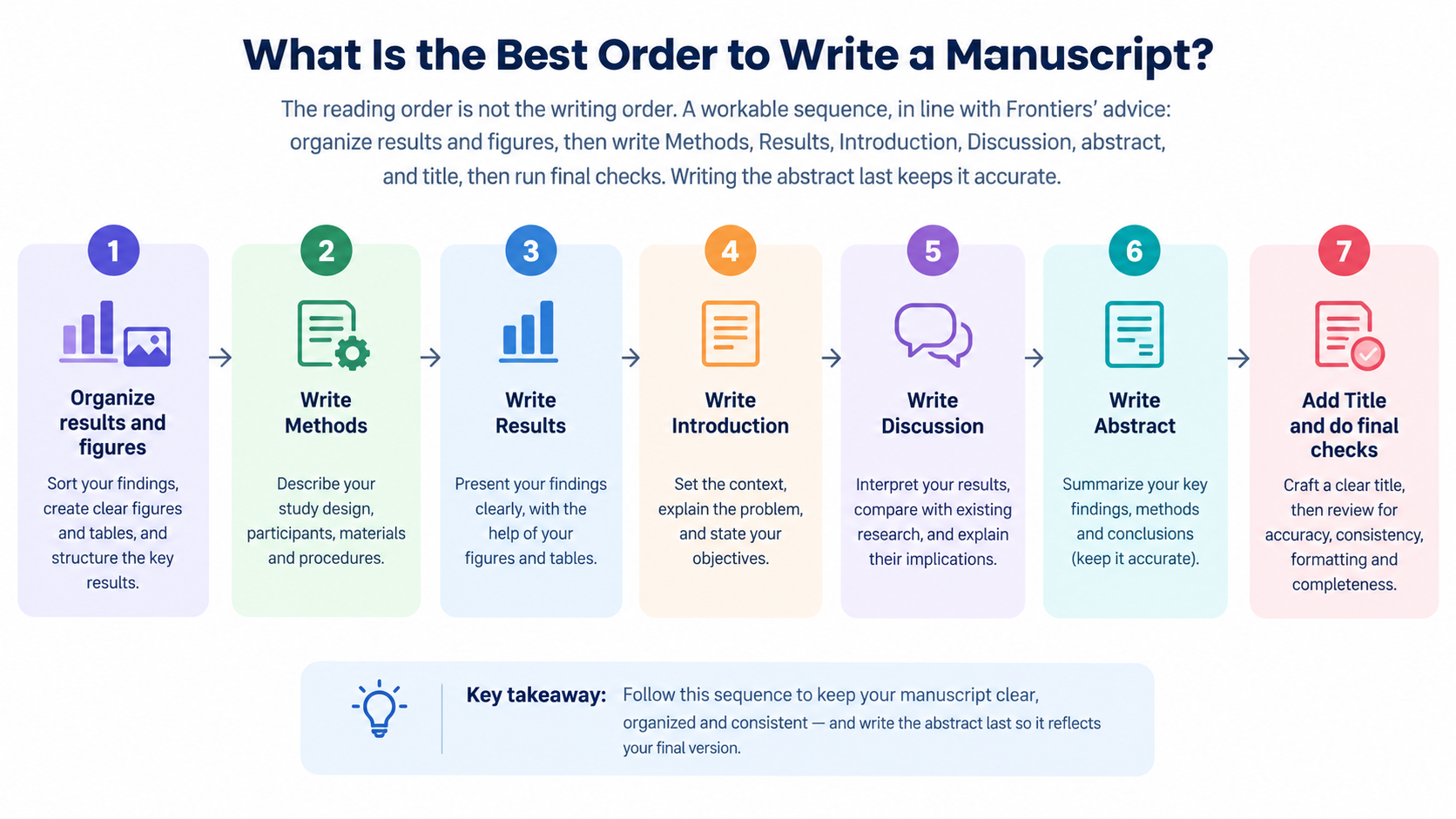
The reading order is not the writing order. A workable sequence, in line with Frontiers’ advice: organize results and figures, then write Methods, Results, Introduction, Discussion, abstract, and title, then run final checks. Writing the abstract last keeps it accurate.
Manuscript Writing Example
Hypothetical study, for illustration only; it contains no real data.
- Objective: Describe how postgraduate students choose and use online research tools.
- Methods outline: survey design, sampling, questionnaire, ethics, and analysis plan.
- Results outline: response rate, tool use by research stage, and differences by discipline.
- Discussion outline: main finding, comparison with prior work, limitations, and practical implications.
Manuscript Formatting Guidelines for Journal Submission
Formatting signals care. Build a checklist from the journal’s instructions:
- Word count, layout, and file types, including figure formats.
- Citation and reference style.
- Tables, figures, and supplementary files.
- Title page and anonymization for double-blind review.
- Language variety, nomenclature, and reporting checklists.
Journal templates reduce errors. Need assistance preparing your document? Learn more about our manuscript formatting service.
Common Manuscript Writing Mistakes
Editors see the same errors repeatedly:
- A research question that does not match the methods.
- An introduction without a clear gap.
- Methods lacking essential detail.
- Results that do not support the conclusion.
- Overclaiming novelty or generalisability.
- Ignoring the journal’s author instructions.
- Incomplete citations or missing disclosures.
Research Ethics and Responsible Use of AI
- Authorship: List only people who meet the journal’s criteria, such as ICMJE’s. Disclose any ghostwriters.
- Originality: Cite every source, and never submit the same paper to two journals at once.
- Human participants: Confirm ethics approval and consent, including patient consent for case reports.
- AI tools: Chatbots cannot be authors. The ICMJE recommendations say to disclose AI use in the cover letter and manuscript, take responsibility for the output, and never cite AI as a primary source. Verify every AI-suggested fact and reference.
- Policies change, so check your journal’s current rules.
How to Edit and Proofread a Manuscript Before Submission
Edit in layers. First, revise the science: does every conclusion follow from the data? Second, edit the language. Third, proofread references, figures, tables, and formatting. Set the draft aside for a week, because flaws then stand out. Independent pre-submission peer review helps when you lack a critical reader, and professional manuscript editing helps with language.
Manuscript Submission Checklist
- The journal scope and article type match your manuscript.
- All sections and files meet the journal’s instructions.
- Tables, figures, citations, and references are accurate and complete.
- Reporting guidelines and ethics requirements are addressed.
- All authors have approved the final version and disclosures.
- The cover letter and required declarations are ready.
How to Write a Journal Submission Cover Letter
Keep it to one page. Name the manuscript, article type, contribution, and journal fit, then confirm declarations. Never promise acceptance.
Dear Editor, please consider our manuscript, “[Title]”, as an original research article for [Journal]. It examines [objective] using [design], adds [contribution], and suits your readers because [reason]. It is original, not under review elsewhere, and approved by all authors. Declarations: [conflicts, funding, ethics, AI use]. Sincerely, [Corresponding author]
For hands-on help with finalizing your submission package, explore our journal submission support services.
Frequently Asked Questions – FAQs
What is manuscript writing in research?
Preparing a structured report of your study for peer review and publication.
How do I start writing a research manuscript?
Write a one-sentence key message, choose a journal, read its instructions, and outline your figures.
What are the main sections of a manuscript?
Title, abstract, keywords, IMRaD sections, references, and declarations.
How long should a journal manuscript be?
It depends on the journal and article type, so check its word limit.
What is the difference between a manuscript and a research paper?
They overlap. A manuscript is the version submitted for review.
Can I write the abstract after finishing the paper?
Yes. Writing it last keeps it consistent with your final results.
How do I prepare a manuscript for journal submission?
Follow the journal’s rules, verify references, confirm ethics and AI disclosure, get author approval, and write a cover letter.