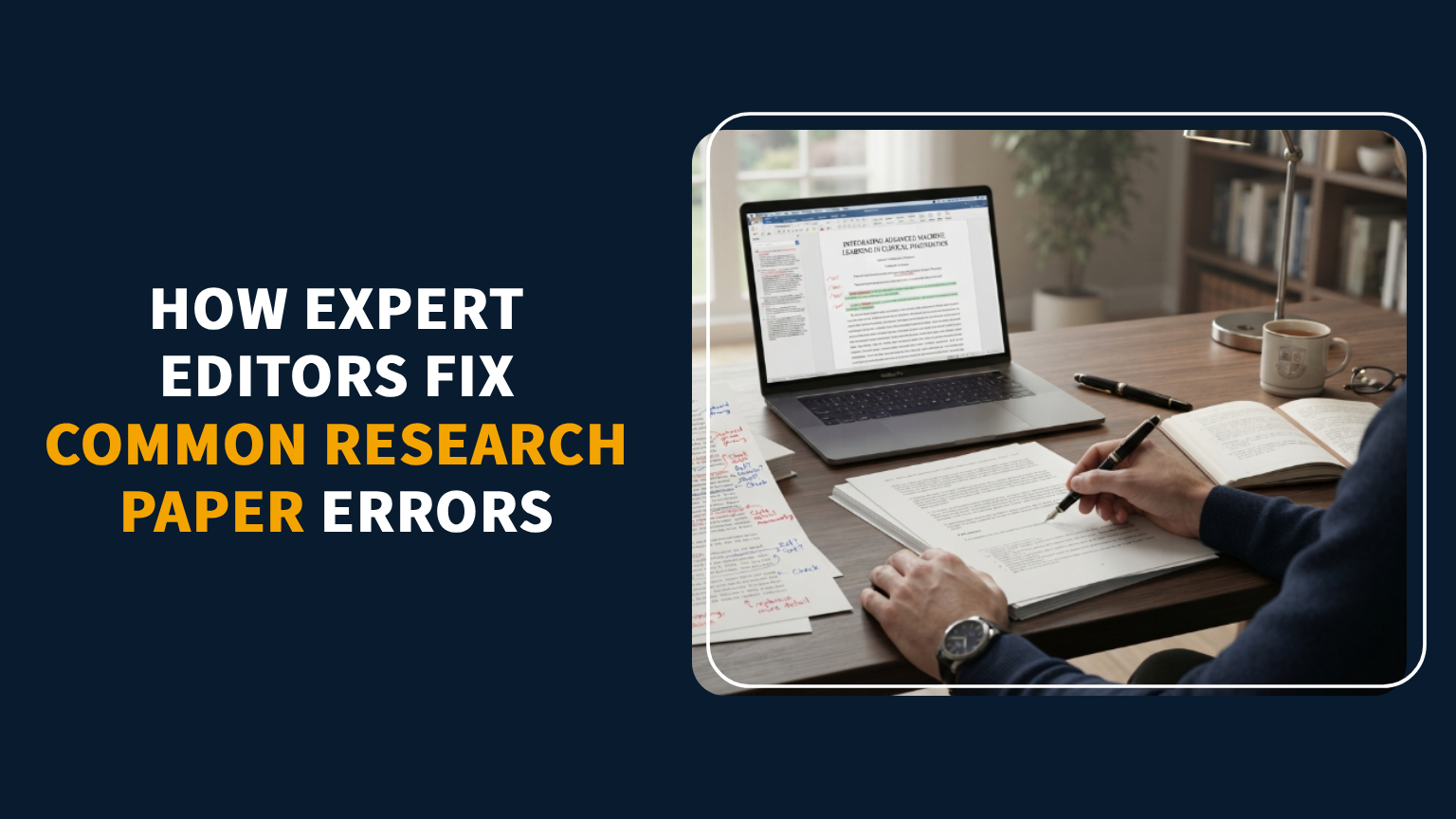
You must have observed that the common research paper errors include a lot of grammar mistakes, incorrect formatting, weak paragraph flow, and citation errors. Expert editors fix these with a well-structured process covering structural review, language correction, clarity analysis, and formatting consistency before a manuscript reaches towards a journal.
Difficulties come with every researcher, even the most strong research study during the revision stage to refrain from making errors. Common research paper errors rarely reflect the quality of the underlying study, but they do shape how reviewers judge it. This guide breaks down where these errors come from, the most frequent ones editors look for, and the exact procedure licensed editors follow to fix them.
Why Research Papers Often Contain Errors
Some Reasons Behind Writing Mistakes
Multiple mistakes trace back to some predictable causes: writing in a second language, working under tight deadlines, and reading your own draft various times to spot its flaws objectively. Co-authored papers add an additional layer, since inconsistent terminology often creeps in when multiple people write diverse sections.
Prolonged research timelines make this worse. A paper written over the past eight or ten months often has sections drafted months apart, in numerous moods and numerous levels of fatigue, which shows up as tonal and stylistic inconsistency by the time everything gets stitched altogether. Added last-minute modifications after a supervisor’s feedback round, and small mistakes multiply quickly in the days before the deadline comes.
Effect of Errors on Journal Acceptance
Manuscript editors and reviewers often equate sloppy writing with sloppy research, even when that’s not fair. A manuscript that has a lot of grammar mistakes in research papers can get desk-rejected before anyone properly evaluates the real findings, which makes cleanup work as major of the science itself.
Editors managing dozens of submissions a week rely on writing quality as a quick filter. A paper that reads cleanly indicates a careful writer, while one riddled with general errors raises doubts about whether the same carelessness extended to the methodology and data analysis, often an unfair assumption, but an ordinary practice.
Most Common Research Paper Errors
Here are five categories that account for the bulk of what licensed editors correct across academic manuscripts.
Grammar and Sentence Structure Mistakes
These are the most common forms of mistakes. These sorts of grammar, and sentence structure errors contain subject-verb disagreement and misplaced modifiers, as well as incorrect tenses used. These are the most general grammar mistakes in research papers, most importantly in methods and results sections where the paragraphs, including the sentences, elongate and become complex rather than being short and easy to read. Past tense should be used in methods and outcomes, while present tense usually applies to interpretation, as well as the facts. Merging these two mid-paragraphs is one of the quickest methods to signal an unrefined written draft of your manuscript.
Incorrect Formatting and Terminology
Switching between “subjects” and “participants” or alternating American and British spelling mid-document, signals a lack of improvement even when the content itself is sound. This is especially discovered more in multi-author papers, where each contributor comes with their own habits from previous publications, and no one does a final consistency examination before submission.
Bad Paragraph Structure and Flow
Paragraphs are written in between ideas without clear transitions that make dense research harder to follow, even for reviewers already familiar with the topic. A useful test is reading each paragraph and examining whether it makes exactly one point. Paragraphs trying to do three things at once are generally the ones that require reorganizing most.
Citation and Referencing Errors
Mismatched in-text citations and reference list entries, missing DOIs, and incorrect journal-specific citation styles are among the most common research paper errors editors catch in the time of formatting revision. These slip through easily because entries can be misformatted silently by the reference manager, and some writers cross-check every citation against the final reference list before the manuscript goes for submission.
Overly Wordy or Ambiguous Sentences
Academic writing frequently defaults to unnecessary difficulties. This research paper mistake is made when sentences stretch past 40 words, which often bury the actual finding under qualifying clauses, making readers reread them just to extract the core claim. Breaking such sentences into two short sentences almost always upgrades clarity without losing any technical precision.
Fast self-check before submission: tense being incorrect, terminology consistency, citation format matches journal style, no sentence over 25–30 words, and every abbreviation defined on first use.
How Expert Editors Identify and Fix These Errors
Grammar and Language Correction
Manuscript editors work sentence by sentence, fixing grammar while preserving the writer’s technical meaning and voice rather than changing the concept.
Before: “The data was collected from participants over a three-month period, which was analyzed using SPSS.”
After: “Data were collected from participants over three months and analyzed utilizing SPSS.”
Structural and Logical Flow Betterment
Beyond sentence-level fixes, editors go through whether each section builds logically on the last, and whether paragraph order supports the paper’s entire argument.
Clarity and Conciseness Enhancement
Overly wordy sentences get trimmed without losing precision, which typically makes technical writing easier to read without changing what it means.
Formatting and Citation Consistency Check
This step of the process verifies that each citation style, heading format, and table format fits best with the target journal’s author guidelines exactly.
Discipline-Specific Terminology Review
A qualified editor cross-checks specialized terms against field conventions, since a general-language editor can miss discipline-specific errors a subject-matter reviewer would pick instantly.
Research Paper Editing vs Self-Editing, Why Experts Make a Difference
Barriers Faced with Self-Editing
Writers are too close to their own writing to pick every mistake in the manuscript, particularly after numerous drafts. Familiarity with the content makes it easy to read what you meant instead of what’s actually on the page. This is a well-documented cognitive pattern, not a personal failing, the brain automatically fills in gaps and corrects errors while reading text it wrote itself, which is exactly why the same typo can survive ten read-throughs by the original author.
The Value of a Second Professional Eye
A trained editor reads with fresh eyes and a checklist mindset, catching patterns of common research paper errors that an author has become blind to after months of writing. They also bring pattern recognition from working across many manuscripts, which means they spot structural issues, like a results section that doesn’t clearly answer the stated research question, that a first-time author might miss entirely.
What Does a Research Paper Editor Do — Step-by-Step Process
Step 1 — Manuscript Assessment
The editor reviews the full manuscript first to understand scope, target journal, and the author’s specific concerns before making any changes.
Step 2 — Language and Grammar Editing
Sentence-level correction happens next, addressing grammar, word choice, and tense consistency throughout the manuscript.
Step 3 — Structural and Flow Review
The editor evaluates paragraph and section order, flagging places where the logical flow breaks down.
Step 4 — Formatting and Citation Check
Citations, references, tables, and figures are checked against the specific journal’s formatting requirements.
Step 5 — Final Quality Check Before Submission
A final read-through confirms consistency across the whole document, sometimes handled as separate journal submission editing once a target journal is confirmed.
Manuscript Assessment → Language Editing → Structural Review → Formatting Check → Final Quality Check
Benefits of Using Research Paper Editing Services
Reduced Risk of Journal Rejection
An error-free, or clean, writing decreases the probability of desk rejection tied purely to presentation instead of a research quality. Multiple journals reject a meaningful share of submissions at the desk stage before peer review even begins, and writing quality is one of the some variables a writer has complete control over at that point.
Improved Readability and Professional Tone
Academic editing services help a manuscript read smoothly for reviewers who may be scanning dozens of submissions in a single sitting. A paper that’s easy to follow gets a fairer read of its actual contribution, rather than losing the reviewer’s attention halfway through a dense paragraph.
Stronger First Impression with Reviewers
Research paper editing services give a manuscript its best possible first impression, which matters because reviewers form early opinions that color how they read everything that follows. Many authors pair this with broader manuscript editing services when English isn’t their first language or the paper is heading to a highly competitive journal.
How to Choose the Right Research Paper Editing Service
Subject-Matter Expertise
Confirm the editor or service has a genuine background in your specific field, not just general academic editing experience. A biology paper and an engineering paper follow very different conventions, and an editor unfamiliar with your discipline may flag correct technical phrasing as an error, or miss one that actually matters.
Turnaround Time
Check realistic turnaround against your submission deadline, especially if you’re editing under time pressure ahead of a conference or journal cutoff. Rush turnaround is available from most services, but it’s worth confirming whether faster delivery means a lighter pass rather than the full multi-step process.
Editing vs Proofreading Scope
Clarify whether the service offers deep structural editing or light proofreading only — these are different levels of support with different price points and outcomes. Proofreading catches surface errors like typos and punctuation, while full editing addresses structure, clarity, and flow as well, which matters more if reviewers already flagged organizational issues in a previous round.
Conclusion
If you face common research paper errors, it really doesn’t mean your research is not good, but they can still cost a manuscript its first chance with a journal. Working on your manuscript’s structure, grammar, clarity, and formatting systematically, whether on your own or with professional academic editing services, gives your research the presentation it deserves.
Frequently Asked Questions
What are the most common research paper errors?
Grammar and sentence structure mistakes, inconsistent terminology, poor paragraph flow, citation errors, and overly wordy sentences are the most frequent issues editors encounter across academic manuscripts.
How do expert editors improve research papers?
They work through a structured process covering language correction, structural flow, clarity, and formatting consistency, rather than making random or surface-level fixes.
Why should you use research paper editing services?
Professional editing catches issues authors are too close to their own writing to notice, reducing the risk of rejection over presentation rather than research quality.
What does a research paper editor do?
An editor assesses the manuscript, corrects grammar and language, reviews structure and flow, checks formatting and citations, and performs a final quality check before submission.
How can I avoid journal rejection due to writing errors?
Run a careful self-edit against a formatting and grammar checklist, then have a second reader or professional editor review the manuscript before you submit it.