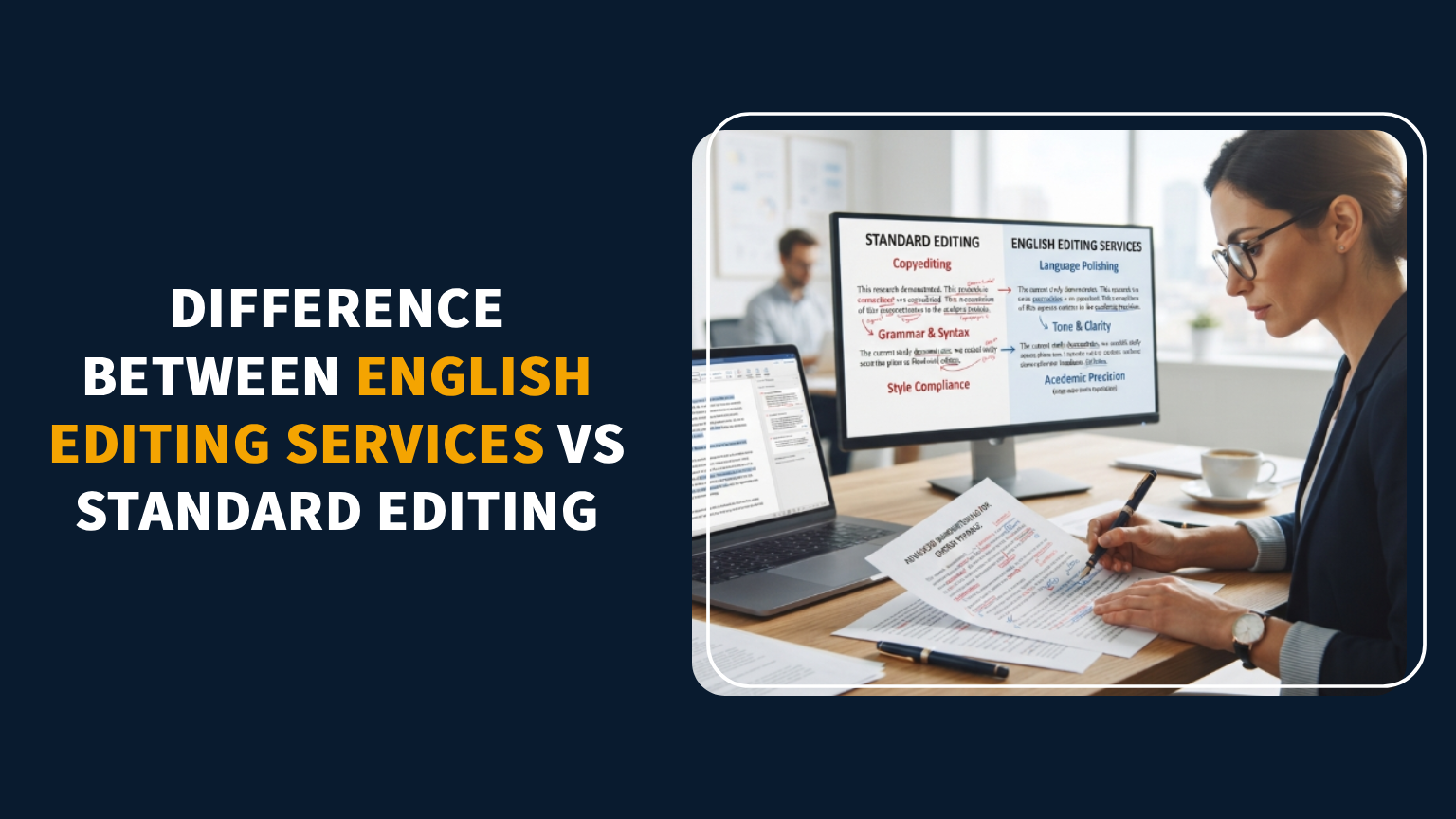
If you’re figuring out what’s the difference between an English editing service vs standard editing, you’re at the right place. The standard editing is all about correcting punctuation, grammar, and basic style of the way you write. But English editing services are quite different from basic editing, such as polishing sentence-level fluency, tone, and native-level phrasing, which makes it necessary for non-native English researchers, and authors following international journal criteria. The right selection solely depends on your language proficiency and your target journal’s criteria.
What is Standard Editing?
Standard editing is defined as the baseline editing service that multiple writers find out first. It focuses on correctness rather than the voice. An editor working at this level examines for spelling errors, punctuation mistakes, subject-verb agreement, and formatting that isn’t even. The goal is a clean, technically make the document accurate, not necessarily a document that reads naturally to a native English speaker.
This makes standard editing a good, wallet-friendly option for writers who already have good command of English and simply need a second set of eyes before the time of submission
Scope of Standard Editing
Standard editing typically involves the following jobs:
- Grammar and punctuation corrections
- Spelling and typo fixes
- Basic sentence structure adjustments
- Consistency in formatting, headings, and citation style
- Light proofreading of the final draft
These are surface-level, mechanical corrections. The editor is not rewriting sentences for tone or flow, they’re looking for the errors that would otherwise distract a reader or reviewer.
What Standard Editing Does Not Cover
Standard editing has clear limits. It does not address:
- Awkward phrasing that is grammatically right, but doesn’t read naturally.
- Idiomatic expressions or word choice that doesn’t match native usage.
- Sentence-level restructuring for flow and clarity.
- Deep errors with argument logic or paragraph transitions.
- Language-level restrictions specified to non-native writers.
For a native English writer with a polished draft, this is generally okay. For an author translating ideas from another language into English, it often isn’t, a sentence can go through any type of grammar examination, and still read as overly literal, stilted, or unclear to a native reader, simply because standard editing was never designed to catch that kind of issue.
What Are English Editing Services?
English editing services are specifically helpful in bridging the language gap for non-native English writers. Rather than only identifying the errors, an English editing service totally reorganizes the sentences so they read the way a native speaker would naturally draft them. This is a comprehensive, more linguistically focused form of editing.
Where standard editing asks, “Is this correct?”, English editing asks, “Does this sound natural, and does it communicate the intended meaning clearly to an English-speaking academic audience?”
Scope of English Editing
English editing typically includes:
- Full grammar and mechanical correction (everything standard editing covers)
- Sentence-level rewriting for natural, fluent phrasing
- Correcting non-native sentence patterns (word order, article usage, prepositions)
- Improving word choice and academic tone
- Ensuring technical terminology is used correctly and consistently
- Enhancing overall readability for an international academic audience
In practice, this is defined as an English editing service might rework a technically accurate but awkward sentence into one that reads the way a native academic writer would phrase it, tightening word order, replacing a literal translation of an idiom with the natural English equivalent, or breaking an overloaded sentence into two clearer ones. None of these changes are “mistakes” in the strict grammatical sense, which is exactly why standard editing lets them go.
Who Needs English Editing Services
English editing services are made for a specific reader profile: writers who know their subject well but did not learn English as a first language. This contains:
- Researchers who write in English as a second or third language
- PhD students who prepare a thesis for an English-speaking committee
- Writers translating or adapting a manuscript originally written in another language
- Teams submitting to journals with rigid English-fluency requirements
Researchers preparing manuscripts for publication often combine academic editing services with language editing to improve clarity, maintain technical accuracy, and meet journal expectations.
Key Differences Between English Editing Services and Standard Editing
The clearest way to compare the two is side by side. While both improve a manuscript, they operate at different depths and solve different problems.
| Comparison Factor | Standard Editing | English Editing Services |
|---|---|---|
| Focus Area | Grammar, punctuation, formatting | Fluency, tone, natural phrasing |
| Language Level Addressed | Surface-level correctness | Deep, sentence-level language quality |
| Grammar & Native Fluency Check | Grammar only | Grammar plus native-level fluency |
| Structure & Clarity Improvement | Minimal | Extensive sentence and paragraph-level rewriting |
| Best For | Native English writers, polished drafts | Non-native writers, journal-bound manuscripts |
| Depth & Turnaround | Faster, lighter touch | Slower, more thorough pass |
The table above highlights the answer to why these two services are interchangeable is a general, and costly, mistake. Any manuscript that requires standard editing rarely takes advantage of paying for a complete English editing pass, and a manuscript that authentically needs English editing will still read awkwardly after standard editing individually.
English Editing vs. Proofreading — How Are They Different?
It helps to place a third term into this comparison, because English editing vs proofreading is one of the most general points of confusion for first-time writers. Proofreading is the final, lightest-touch analysis in the entire editing process. It picks up leftover typos, missing punctuation, and formatting faults right before submission, nothing else.
English editing, by contrast, occurs earlier, and consists of a technical form of editing. It actively checks how sentences are written so the manuscript sounds quite natural to a native-English academic reader. Proofreading assumes the language is already fluent and just requires a final polish; English editing assumes the language itself requires polishing..
A practical way to think about it: proofreading is a spell-check with involvement of a human, while English editing is a rewrite for adding fluency. Skipping straight to proofreading when a manuscript actually requires English editing is one of the most major reasons manuscripts are returned with language-related revision requests.
When Do You Need English Editing Services?
Non-Native English Speakers
If English is not your first language, the pattern of sentences you follow from your native language frequently carry over into your writing, even when your grammar is technically accurate. English editing services spot these patterns and fix them so the writing reads naturally to a native audience.
Manuscripts with Difficult Technical or Scientific Content
Dense academic or scientific writing leaves little room for ambiguity. When a complicated procedure or information is demonstrated in slightly unnatural English, reviewers can misread the intended meaning, or worse, question whether a finding is actually valid because the description of it is unclear. It can be higher in risk in fields such as engineering, clinical research, and the physical sciences, where an individual ambiguous sentence explaining a process or outcome can raise questions in the middle of peer review that have nothing to do with the actual quality of the research. English editing services are specifically valuable here because they preserve technical accuracy while making better clarity, working sentence by sentence without altering the underlying data or findings.
Journal Submission Language Requirements
Many international journals explicitly prove that submissions must meet a native or near-native English standard before peer review begins.
English may not be their first language. In such cases, English editing isn’t optional, it’s a prerequisite for the manuscript to be considered at all, and skipping it can mean a paper is desk-rejected before a single reviewer ever reads the actual research.
In these situations, professional editing services can help authors meet journal language standards before submission and reduce the likelihood of language-related revisions.
Get your work recognized on global research platforms with our expert guidance TODAY!
When is Standard Editing Enough?
Native English Writers
Writers who learned English as a first language rarely need sentence-level language correction. Their drafts generally just require a careful go-through of the grammar slips, typos, and formatting consistency, all of which you get from the standard editing.
Small Grammatical & Style Mistakes
If your manuscript is already written beautifully, and only has occasional little mistakes, a full English editing pass is unnecessary. Standard editing efficiently resolves these minor issues without adding cost or turnaround time.
Early-Stage Manuscripts and Internal Drafts
For working drafts, internal reviews, or early-stage manuscripts not yet ready for submission, standard editing offers a fast, affordable way to clean up the text before deeper revisions happen.
Benefits of Choosing the Right Editing Service
Getting the right information on the difference between English editing services vs standard editing helps authors choose the most suitable editing option before journal submission.
1. Better Readability and Clarity
With the right editing service, you get your editing service matched to the actual manuscript’s criteria, producing writing that perfectly communicates the ideas, without unnecessary back-and-forth revisions during peer review.
2. Greater Chances of Journal Acceptance
Editors and reviewers are far more likely to engage seriously with a manuscript that reads smoothly. Language issues can distract from otherwise strong research, sometimes leading to rejection on language grounds alone. High-quality journal editing services can improve clarity and presentation, allowing reviewers to focus on the research instead of language issues.
3. Publication-Ready Manuscript
Ultimately, opting between these options comes down to getting your manuscript publication-ready the first time. For authors who aren’t sure which route to take, working with professional English editing services ensures the language quality matches the standard journals expect, reducing the risk of delays caused by preventable language issues.
Investing in professional editing services before submission can save valuable revision time and improve the overall presentation of your research.
How to Choose Between English Editing and Standard Editing
Assess Your Language Proficiency
Be honest about your comfort writing in English. If you frequently translate thoughts from another language before writing them down, or if colleagues have mentioned your writing is “hard to follow” despite being grammatically fine, English editing will likely serve you better than standard editing alone. A simple test: read a paragraph of your draft aloud. If it sounds noticeably different from how a native English-speaking colleague would phrase the same idea, that’s a strong signal you need language-level editing rather than a grammar pass.
Check Target Journal Requirements
Before choosing a service, check whether your target journal has specific language-quality expectations. Some journals request an English-editing certificate as part of the submission package.
Consider Manuscript Complexity and Length
Longer, more technical manuscripts carry more risk of language-related misunderstandings. The more complex the content, the more a thorough English editing pass tends to pay off.
Quick Decision Checklist — Which Editing Service Do You Need?
- Native English writer, minor errors only → Standard editing
- Non-native writer, clear but imperfect English → English editing services
- Complex technical/scientific manuscript → English editing services
- Journal requires a language certificate → English editing services
- Internal draft, not yet submission-ready → Standard editing
- Final check before submission (already fluent) → Proofreading
Conclusion
Knowing the difference between English editing services vs standard editing helps researchers select the most appropriate service for their manuscript and publication goals. Standard editing fixes grammar, punctuation, and formatting, ideal for native English writers with mostly clean drafts. English editing services go deeper, rebuilding sentences for natural fluency, which matters most for non-native writers and journal-bound manuscripts. Matching the service to your actual language needs, rather than defaulting to the cheaper or faster option, is what ultimately protects your manuscript from language-related rejection and gets it publication-ready.
Frequently Asked Questions (FAQs)
What is the difference between English editing and standard editing?
The key difference between the standard editing is that it fixes spelling, grammar, spelling, and formatting. English editing is a lot different than standard editing. Standard editing consists of polishing sentence fluency and natural phrasing, for making it suit better to non-native English writers.
Which editing service should I choose?
Select, based on your language proficiency and your manuscript’s technicality. Native writers with clean drafts generally require standard editing; and the non-native writers require English editing services.
Do I need English editing for journal publication?
If English is not your first language, or your target journal requires a language-quality certificate, English editing is typically necessary before submission.
What does an English editing service include?
The English editing service contains grammar correction as well as the sentence-level rewriting for fluency, natural word selection, and improved readability for an English-speaking academic audience.
English editing vs. proofreading: What’s the difference?
Proofreading is a final, light check for leftover typos. English editing is a technical method that reshapes sentences for natural, native-level fluency earlier in the writing procedure.
Which editing service is best for research papers?
For non-native writers or technically dense research papers, English editing services are usually the better choice, since they resolve both fluency and clarity.