Scientific editing is a specialized editorial method that upgrades a research manuscript’s clarity, terminology, structure, and compliance with journal standards before it gets submitted or published. Unlike basic proofreading, it resolves the logical flow, scientific argument, and research paper editing requirements at a technical level, assisting authors in avoiding desk rejection and presenting their work the way peer reviewers expect it to be.
What is Scientific Editing?
If you’ve this question, what is scientific editing, on your mind? The short answer is this: it’s the procedure of polishing a research manuscript so its science talks as clearly as the research itself talks. Scientific editing is much more than just fixing typos, it goes through whether your argument holds together, whether your terminology is consistent, and whether a reviewer not familiar with your specified subfield can trace your reasoning from introduction to final verdict. For most authors, this is the difference between manuscript editing that simply “cleans up” a draft and editing that meaningfully strengthens the paper’s chances of acceptance.
Scientific Editing vs Copyediting vs Proofreading
The debate of proofreading vs. scientific editing comes up often, and the distinction is important. Proofreading picks up punctuation, surface-level errors, spelling, and formatting slips, after everything else finishes. Copyediting goes through a more intense layer of correcting grammar and sentence-level style. Scientific editing comes on top: it evaluates whether your information is 100% logical, whether your discussion actually answers your research question, and whether journal-specific conventions are met. A manuscript can be grammatically perfect, and still fail scientific editing standards if the argument doesn’t hold up.
Who Performs Scientific Editing?
Scientific editing is generally performed by subject-matter professionals, usually PhD-qualified editors with publishing experience in the writer’s particular discipline, rather than generalist copyeditors. This way, the phrase academic editing for researchers is separated from a standard language analysis: the editor points out the conventions of your field well enough to flag scientific inconsistencies, not just linguistic ones.
Why Do Researchers Need Scientific Editing?
Even powerful research can be undervalued, misunderstood, or rejected outright if it isn’t communicated clearly. This is where scientific editing earns its place in the publication workflow.
Overcoming Language and Clarity Barriers
For non-native English speakers especially, English editing for scientific papers assists in making sure that the difficult concepts aren’t lost in translation. Reviewers are interested mostly in engaging seriously with a manuscript that reads smoothly rather than one they have to decode sentence by sentence.
Meeting Journal-Specific Formatting and Style Standards
Each journal has its own writer’s citation style, guidelines, word limit, section order, and figure requirements. Scientific editing guarantees that your manuscript aligns with the required expectations precisely, reducing the risk of an editor bouncing your paper back before it even reaches peer review.
Strengthening Scientific and Logical Flow
A scientific editor analyzes whether all the sections include data that is highly accurate in the entire manuscript: Is your introduction setting the gap your study fills? Is your discussion actually addressing your outcomes, or is it drifting into unsupported claims? This kind of structured review is central to effective manuscript editing.
When Researchers Should Seek Professional Support
Some sections of a manuscript are simply harder to get right, such as a nuanced discussion section, a response to conflicting literature, or a conclusion that needs to land with precision. When authors find themselves stuck on these technically or emotionally demanding parts of the writing process, that’s usually the signal to bring in dedicated scientific editing services rather than continuing to self-edit in circles.
Types of Scientific Editing Explained
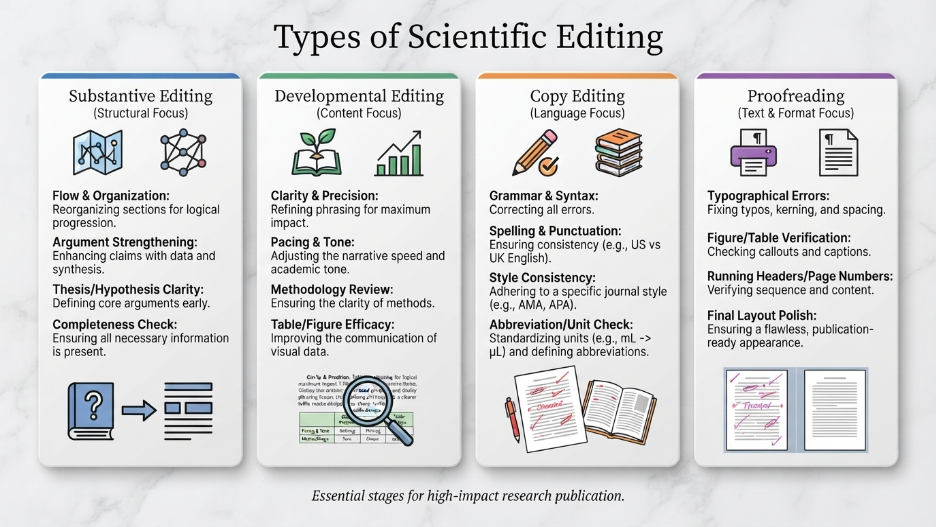
Getting an idea of what is scientific editing in practice means getting an idea that it isn’t a single service, it covers several distinct layers of manuscript editing, each addressing a diverse part of the manuscript.
Substantive / Developmental Editing
This is the highest-level editing, checking the manuscript’s entire argument, structure, and scientific reasoning. It often consists of reorganizing sections or recommending extra analysis to strengthen the paper’s core claims.
Line Editing and Language Polishing
Here, the concentration narrows to sentence-level clarity, tightening phrasing, fixing grammatical errors, and improving readability without having to make any alterations to scientific meaning.
Subject-Matter and Technical Editing
A discipline-specific editor examines units, terminology, field, and statistical reporting conventions to make sure the paper reads as credible to specialists in that area.
Formatting and Journal-Compliance Editing
This final layer handles manuscript preparation for publication, aligning citations, headings, figures, and tables with the target journal’s exact submission template.
| Editing Type | Focus | Typical Timing |
|---|---|---|
| Substantive/Developmental | Argument, structure, logic | Before first submission |
| Line Editing | Sentence clarity, grammar | After structural review |
| Technical/Subject-Matter | Terminology, data accuracy | Mid-process |
| Formatting/Compliance | Journal template, citations | Final step before submission |
What Does a Scientific Editor Actually Check?
At the core of what is scientific editing in day-to-day practice is a checklist most editors apply consistently, no matter the discipline. A thorough research paper editing review typically covers:
- Syntax, grammar, and word selection.
- Consistency in abbreviations and terminology.
- Section flow, and logical structure.
- Accuracy of information presentation (tables, figures, statistics)
- Compliance with standard journal guidelines
- Reference formatting and citation.
The Scientific Editing Process – Step by Step
Most professional providers follow a structured version of what is scientific editing in practice:
Step 1 – Manuscript Scope Definition and Assessment
The editor reviews the manuscript to identify its current state and determine which level of editing it needs.
Step 2 – Content Structure and Review
Sections are checked thoroughly for argument strength, logical order, and whether the outcomes genuinely support the conclusions drawn.
Step 3 – Style Editing and Language
The tone, grammar, and sentence-level clarity are polished in your overall manuscript.
Step 4 – Formatting for Journal Submission
There are adjustments made in the paper to match the standard style of the journal and submission requirements.
Step 5 – Query Resolution and Author Review
Authors review suggested modifications and respond to any editor issues about ambiguous information or unclear claims.
Step 6 – Final Proofread Before Submission
A last pass spots out any leftover typographical or formatting mistakes, before the manuscript goes for submission.
Get your work recognized on global research platforms with our expert guidance TODAY!
How Scientific Editing Improves Your Chances of Publication
Getting the right knowledge of what is scientific editing contributes in practical terms comes down to how it changes an editor’s or reviewer’s first impression of your work.
Creating a Stronger First Impression on Editors
A refined, structured manuscript shows professionalism and increases the likelihood that an editor sends it out for proper peer review instead of a desk rejection.
Decreasing Desk Rejections
Multiple manuscripts are disapproved before peer review simply because of formatting non-compliance or unclear writing, errors scientific editing is particularly designed to identify.
Helping Reviewers Concentrate on Science, Not Language
When language restrictions are removed, reviewers can assess the actual research rather than getting distracted by unclear phrasing, directly supporting peer review readiness.
End-to-End Publication Management
A few researchers, particularly first-time writers or non-native English speakers, take advantage of more than a single edit session. A combined journal publication service that manages your editing, formatting, and publication together removes much of the guesswork from getting a paper journal-ready.
Who Should Use Scientific Editing Services?
- PhD students and early-career researchers
- Non-native English-speaking authors
- Researchers targeting high-impact journals
- Teams resubmitting after major revisions
This kind of academic editing for researchers is especially valuable for anyone submitting to a journal for the first time, where the margin for formatting or clarity errors is smallest. It’s also worth considering even for experienced authors moving into a new sub-field or targeting a journal with unfamiliar formatting conventions, since editorial expectations can vary significantly between publications and disciplines.
Mistakes Researchers Make Without Scientific Editing
- Submitting before addressing structural issues
- Relying only on spell-check tools
- Ignoring journal-specific author guidelines
- Inconsistent terminology across sections
- Overlooking figure and table clarity
How to Choose the Right Scientific Editing Service
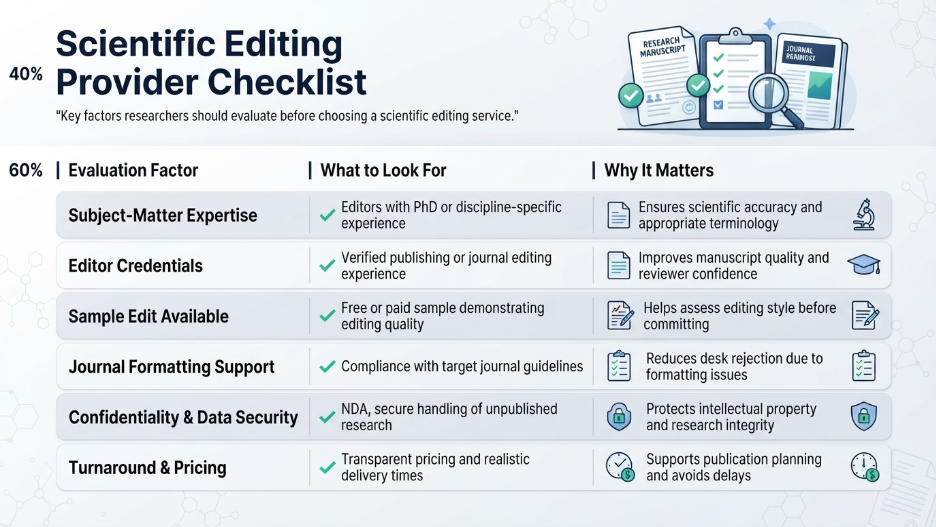
Not all professional editing for researchers is equal, so it’s worth evaluating a few key factors before choosing a provider.
Subject-Matter Expertise
Confirm the editor assigned to your paper has a genuine background in your specific research area, not just general science editing experience.
Turnaround Time and Pricing
Compare estimated delivery timelines against your submission deadline, and check whether pricing is transparent and tied to manuscript length or complexity.
Sample Edits and Editor Credentials
Ask for a sample edit before committing, and review how clearly the service documents its changes:
| Reviewer Comment | Author Response | Manuscript Change / Location |
|---|---|---|
| Clarify statistical method used in Section 3.2 | Added explanation of test selection rationale | Methods, para. 2 |
| Discussion doesn’t address limitations | Added new limitations paragraph | Discussion, final section |
| Inconsistent terminology for key variable | Standardized term throughout | Results & Discussion |
Confidentiality and Data Protection
Since manuscripts often consist of unpublished information, confirm the provider has clear confidentiality and data-security policies in place before sharing your work.
Costs You Should Expect in 2026 and 2027
The pricing for scientific editing typically depends on the length of your manuscript, subject technicality, and turnaround speed. Standard manuscript preparation for publication timelines generally varies from a few days for shorter papers to one to two weeks for longer or extremely technical manuscripts, with expedited options available for making sure not to miss any deadlines. Rather than opting for the most wallet-friendly option, it’s worth weighing cost against editor qualifications and the thoroughness of the review, a rushed or under-qualified edit can end up in complete wastage of your time and money.
Word count also plays a crucial role: a 5,000-word manuscript with a straightforward process will usually cost little, and move faster than a 10,000-word paper with dense statistical reporting or numerous supplementary files. Authors working toward a particular submission window should factor in buffer time for the author-review step, since solving editor problems and approving final changes is rarely instant. Building this into your publication timeline early, instead of treating editing as a last-minute step, tends to offer a smoother, stress-less way to finalization of your manuscript.
Conclusion
At its core, what is scientific editing comes down to is a single most important goal: making sure your research is not only read, but recognized the way you intended it to be. From structural review to journal-compliance formatting, scientific editing closes the gap between powerful, and detailed research and a manuscript that’s genuinely ready for peer review. For researchers experiencing their first submission, or their tenth, investing in a great editor is often what separates a smooth review process from a frustrating one.
Frequently Asked Questions (FAQs)
Is scientific editing the same as proofreading?
No. Proofreading only catches surface-level errors like spelling and punctuation, while scientific editing reviews structure, argument, and scientific accuracy at a much deeper level.
How much does scientific editing cost?
Cost varies by manuscript length, subject complexity, and turnaround time, so it’s best to request a quote based on your specific paper.
Can scientific editing guarantee journal acceptance?
No service can guarantee acceptance, since journal decisions depend on the research itself, but scientific editing significantly reduces rejections caused by clarity or formatting issues.
How long does scientific editing take?
Turnaround typically ranges from a few days for shorter papers to one to two weeks for longer, technical manuscripts, with faster options often available.
Do I need scientific editing if English is my first language?
Yes, scientific editing addresses structure, logic, and journal compliance, not just language fluency, so it benefits native and non-native speakers alike.
What is the difference between scientific editing and technical editing?
Technical editing focuses narrowly on subject-specific terminology and data accuracy, while scientific editing takes a broader view that also includes structure, argument, and overall readability.