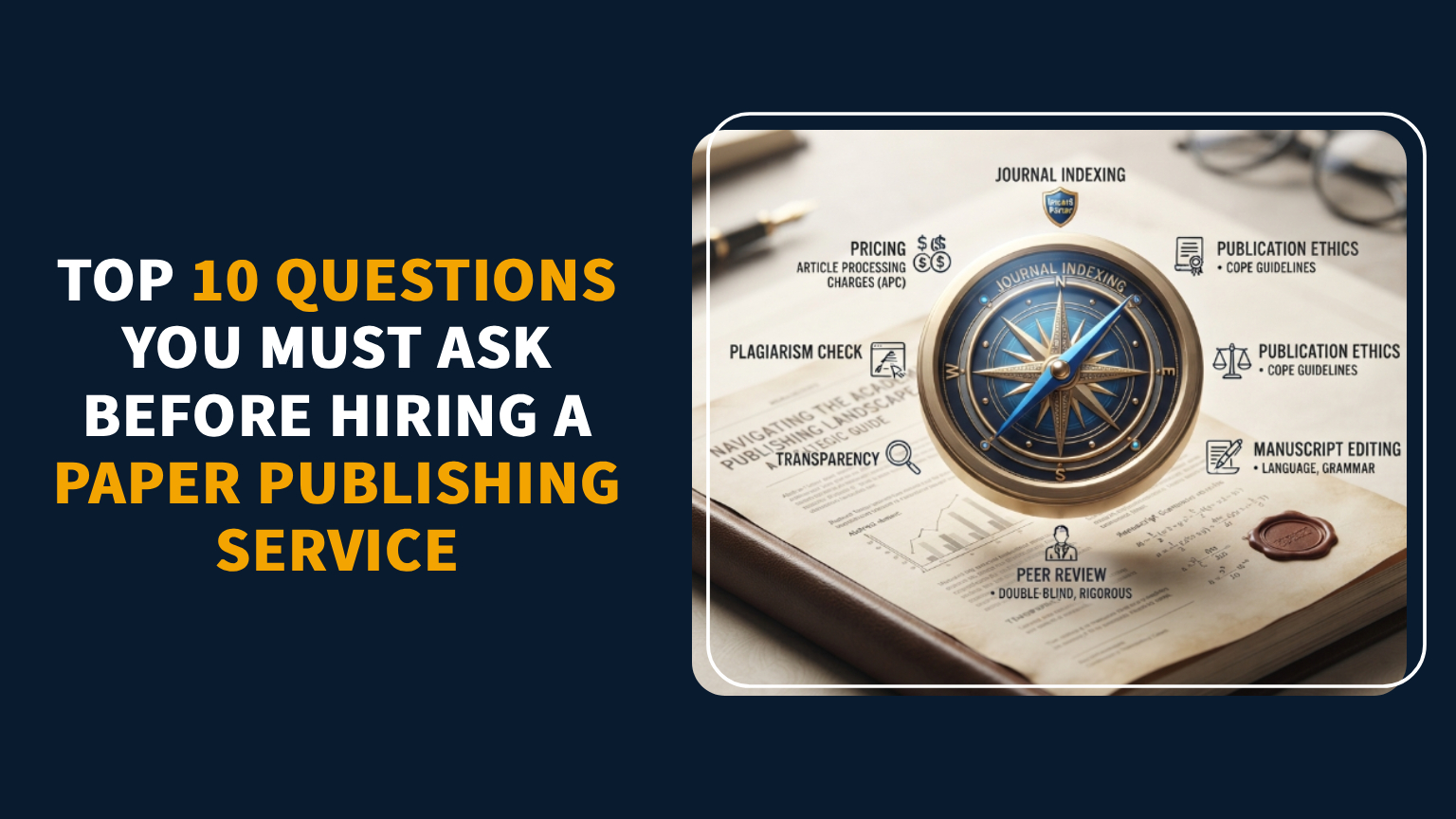
Before hiring a research paper publishing service, verify the specific journals it works with, their current indexing status, the provider’s publication-ethics practices, and whether its claimed results can be independently verified.
If you’re a PhD student, researcher, or early-career academic considering professional publication support, choosing the right provider involves far more than comparing freelancers or package prices.
Before you hire a publication service, verify five things first: the specific journals it recommends, their current indexing status, the qualifications of the people handling your manuscript, the exact services included in the price, and whether the provider makes realistic claims about acceptance.
A trustworthy provider: explains its process, identifies relevant journals, names or describes its experts, provides clear pricing, respects authorship, supports revisions, and allows independent verification.
A questionable provider: guarantees acceptance, avoids specific journal information, hides its team, uses vague pricing, pressures you to pay, or claims to control editorial decisions.
Why Choosing the Right Research Paper Publishing Service Matters
Risks of Hiring the Wrong Publication Service
Academic publishing includes legitimate journals alongside predatory publishers, so researchers should be especially cautious of services that advertise guaranteed acceptance, unusually fast publication, or access to journals without meaningful peer review. The consequences can extend beyond wasted fees: a journal may not meet your institution’s requirements, provide the expected level of peer review, or offer the indexing and visibility you need for your academic goals.
How the Right Service Impacts Journal Acceptance
A legitimate journal publication service does not attempt to bypass peer review; instead, it improves the parts of the submission process you can control, including manuscript clarity, formatting, ethical disclosures, submission requirements, and journal fit.
A structured pre-submission review can help remove avoidable problems before editorial screening, but it cannot determine how editors or peer reviewers will ultimately evaluate the research.
A legitimate publication service can improve your manuscript and submission process, but it cannot control an independent journal’s editorial decision or peer-review outcome.
Top 10 Questions to Ask Before Hiring a Research Paper Publishing Service
1. Which Specific Journals Do You Work With, and Where Are They Indexed?
Ask for the journal’s exact title and ISSN, then verify the journal independently. A provider’s claim that a journal is “Scopus indexed” or “Web of Science indexed” should never be your only source of verification.
Be cautious if a provider refuses to identify specific journals, cannot provide verifiable publication examples, or repeatedly recommends unfamiliar journals without explaining their scope, publisher, indexing status, and editorial standards.
2. What Manuscript Editing and Formatting Support Is Actually Included?
Ask whether editing and formatting are included in the quoted price, who will perform the work, and whether the editor has relevant experience in your academic field. Subject-matter expertise can be particularly important in technical fields, where an editor must improve clarity without changing scientific terminology, methodology, results, or meaning.
3. How Do You Check for Plagiarism and Research-Integrity Issues?
Ask which plagiarism or similarity-checking method is used, when the manuscript is checked, how the results are interpreted, and how potential problems are addressed before submission.
A vague assurance that a manuscript is “plagiarism-free” is not enough; the provider should be able to explain its quality-control process and distinguish legitimate similarity from problematic duplication.
4. How Do You Measure Your Publication Success Rate?
If a provider advertises an acceptance or publication success rate, ask how it was calculated, which journals were included, what period it covers, and whether the results are broken down by journal quality or indexing status.
A single overall percentage can be misleading, so evaluate any success-rate claim alongside the journals targeted, their indexing status, submission volume, and the proportion of manuscripts that were actually accepted.
5. How Do You Handle Publication Ethics, Authorship, and Research Integrity?
Ask whether the provider follows recognized publication ethics principles, such as COPE guidance, and how it handles authorship, conflicts of interest, plagiarism, data integrity, corrections, and other ethical concerns. Ask what would happen if an authorship dispute, questionable data, plagiarism concern, or conflict of interest arose; a clear, documented process is a stronger trust signal than a generic claim that the company “follows ethics.”
6. Will You Support Reviewer Responses and Resubmission?
Reviewer comments and revision requests are a normal part of academic publishing, so ask in advance whether the provider will support you after the initial submission. Confirm whether reviewer-response assistance, manuscript revisions, and resubmission support are included in the package or charged separately, and exactly where the provider’s responsibility ends.
7. Who Handles Journal Selection and Submission?
A publication service should be able to explain why a particular journal is appropriate for your manuscript and how the submission will be prepared to meet that journal’s requirements.
Ask who selects the target journal, who prepares the submission, who communicates with the journal, and whether you retain control and approval of the final manuscript and submission.
8. What Exactly Is Included in the Publication Package and What Costs Extra?
Ask about confidentiality as well: Find out who can access your manuscript, whether it is shared with third parties, how files are stored, and whether your unpublished research remains confidential.
Request a written, itemized breakdown covering editing, formatting, journal selection, submission handling, similarity checks, reviewer-response support, resubmission, and any third-party or journal fees. A vague “full-service” package can create unexpected charges, so make sure every deliverable, exclusion, revision limit, and additional fee is documented before you pay.
9. How Much Will the Service Cost, and When Do I Have to Pay?
Before paying, ask what happens if the journal rejects the manuscript. Find out whether resubmission, journal transfer, additional editing, or a new submission fee will apply.
Ask when each payment is due, whether fees are divided into milestones, which costs are paid to the service versus the journal, and what happens if the manuscript is rejected. An upfront fee is not automatically evidence of an unreliable provider, but you should understand exactly what it covers, what happens after rejection, and whether additional charges can arise later.
10. Can You Provide Independently Verifiable Case Studies or Client References?
Ask for specific, independently verifiable case studies or client references rather than relying only on testimonials published on the provider’s own website. Where appropriate and with the client’s consent, an independent reference can help you verify whether the provider’s stated services, communication, timelines, and results match real client experiences.
The most important distinction is simple: a legitimate service sells expertise and support; an unreliable service sells certainty about an outcome it does not control.
7 Red Flags to Watch for Before Hiring a Publication Service
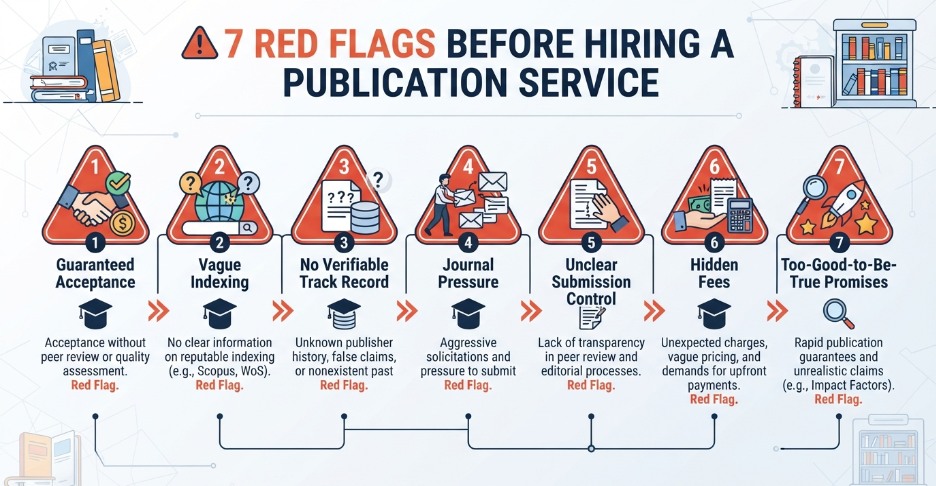
Wondering about the red flags, before you hire a research paper publishing service, here’s a diagram that is going to help you flag the warning signs.
1. Guaranteed Journal Acceptance
No legitimate provider can guarantee acceptance into a genuinely peer-reviewed journal, since the decision sits entirely with that journal’s independent editorial and review process. Treating any explicit acceptance guarantee as a serious warning sign, it usually means the “journal” in question either isn’t genuinely peer-reviewed or accepts submissions with minimal real scrutiny.
2. Vague or Unverifiable Indexing Claims
If a provider cannot clearly identify the databases in which its recommended journals are currently indexed, pause before paying and verify the claims independently. A transparent provider should be comfortable giving you the exact journal name, ISSN, publisher, and claimed indexing status so you can verify the information yourself.
3. No Independently Verifiable Track Record
Be cautious when a provider has no independently verifiable publication history, uses only generic testimonials, provides little information about its team, or cannot demonstrate relevant academic publishing experience. A lack of transparency about the people, company, services, and publication record behind a provider should prompt additional verification before you share a manuscript or make a payment.
4. Pressure to Choose a Journal Without Explaining Why
Be cautious if a provider pushes you toward a particular journal without explaining its scope, audience, indexing, publisher, publication model, and suitability for your research.
5. Unclear Ownership or Submission Control
You should know who owns the manuscript, who controls the journal submission account, who communicates with the editor, and whether you approve the final version before submission.
6. Hidden or Repeated Additional Fees
A low initial quote can become expensive if essential services are excluded from the package. Ask for every expected fee in writing before committing.
7. Promises That Sound Too Good to Be True
Be skeptical of claims such as “guaranteed Scopus publication,” “100% acceptance,” “publication without peer review,” or unusually short publication timelines presented as certain outcomes.
How to Verify a Research Paper Publishing Service Before You Pay
Don’t verify a journal only through the publishing service that recommended it. Start with the exact journal name and ISSN, check its current indexing through the relevant official database, confirm the publisher and editorial information, review its peer-review and publication policies, and compare recent articles with the journal’s stated scope.
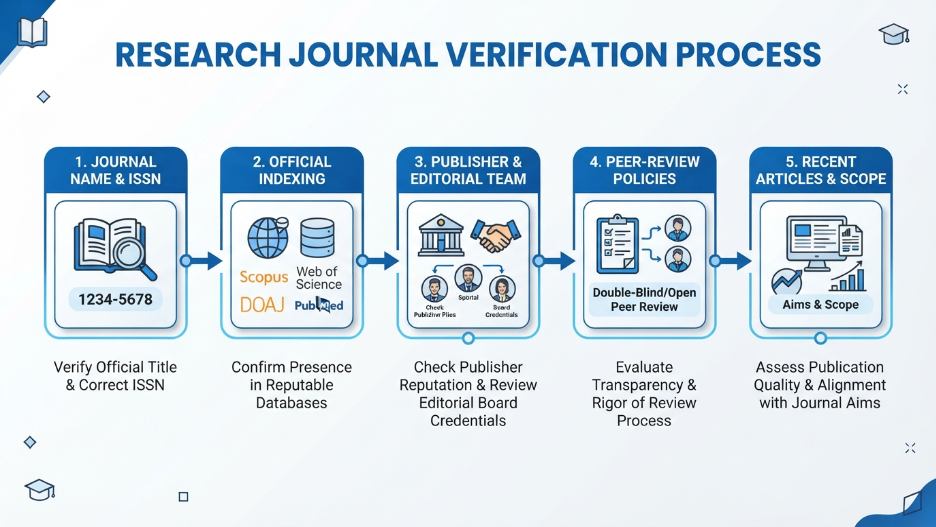
1. Verify the Journal’s Current Indexing Status
Search the exact journal title and ISSN in the relevant official database or directory, and verify the result independently rather than relying on an indexing badge or claim displayed by the service.
2. Check Independent Reviews and Complaints
Search the provider’s name alongside terms such as “review,” “complaint,” or “experience,” and compare independent feedback with the testimonials published on the provider’s own website.
3. Ask for Relevant Samples, Case Studies, or Expert Credentials
A reputable provider should be able to demonstrate relevant experience through appropriately redacted editing samples, verifiable publication examples, case studies, or the credentials of the specialists handling manuscripts. Ask who will actually work on your manuscript and what qualifications or publishing experience they bring; the people providing academic support should be more than sales representatives making promises on behalf of an unnamed team.
A journal can look professional and still be unsuitable for your academic requirements, so verify not only whether it is legitimate but also whether it is appropriate for your field, institution, research objectives, and required indexing status.
What Legitimate Publication Support Can Actually Help With
A More Efficient and Compliant Submission Process
A structured pre-submission review can identify formatting, scope, documentation, and compliance problems before submission, reducing avoidable delays and some common causes of desk rejection.
Clearer, More Consistent Manuscripts
Professional editing can improve clarity, structure, language, and consistency, particularly when a manuscript must meet strict journal guidelines or communicate complex research precisely. A research publication expert with relevant subject-area and publishing experience may also identify discipline-specific issues that a general proofreader could overlook, such as terminology, methodological descriptions, reporting conventions, and journal-specific expectations.
Fewer Avoidable Reasons for Rejection
No service can guarantee acceptance, but improving manuscript clarity, journal fit, formatting, documentation, and ethical disclosures can reduce several avoidable problems that may lead to rejection before substantive peer review.
Read this Quick Checklist Before You Pay
- Exact target journal identified
- Current indexing independently verified
- Publisher and ISSN confirmed
- Editor or subject specialist identified
- Services and exclusions provided in writing
- Total cost and additional fees understood
- Rejection and resubmission policy explained
- Authorship and manuscript ownership protected
- Confidentiality practices explained
- No guaranteed-acceptance claims
- Independent case studies or references checked
To Sum Up
Choosing a research paper publishing service should come down to verifiable evidence, not marketing promises, so ask specific questions, check the answers independently, and understand exactly what the provider can and cannot control. The strongest providers are transparent about journal selection, indexing, pricing, authorship, confidentiality, and their actual role in the publication process, and they should be comfortable with you independently verifying their claims.
If a provider guarantees acceptance, refuses to identify or verify its target journals, hides important fees, or pressures you to pay before you understand the service, treat those signals as reasons to pause or walk away.
Frequently Asked Questions – FAQs
Is a research paper publishing service worth the cost?
It can be worthwhile when the service provides genuine value through manuscript editing, journal-fit analysis, formatting, submission preparation, or reviewer-response support rather than promising to bypass or control peer review.
Can a research paper publishing service guarantee journal acceptance?
No legitimate service can guarantee acceptance by an independent peer-reviewed journal because the final editorial and peer-review decision belongs to the journal.
How can I avoid predatory journals and unreliable publication services?
Verify the journal’s current indexing and publisher information independently, check the provider’s reputation and credentials, and be especially cautious of guaranteed acceptance, unusually fast publication, or vague claims about journal quality.
How much does a research paper publishing service cost?
Costs vary according to the level of support, such as editing, formatting, journal selection, submission management, and reviewer-response assistance, so compare providers using itemized quotes rather than headline package prices.
Should PhD students use research paper publication services?
PhD students may benefit from professional editing, formatting, journal-selection, or submission support, particularly when navigating their first publication, but they should independently verify the provider’s journal and indexing claims.
Are research paper publication services legitimate?
Many publication services are legitimate, but quality varies. Evaluate a provider based on transparent journal information, relevant expertise, publication-ethics practices, clear pricing, verifiable experience, and realistic claims about what it can influence.