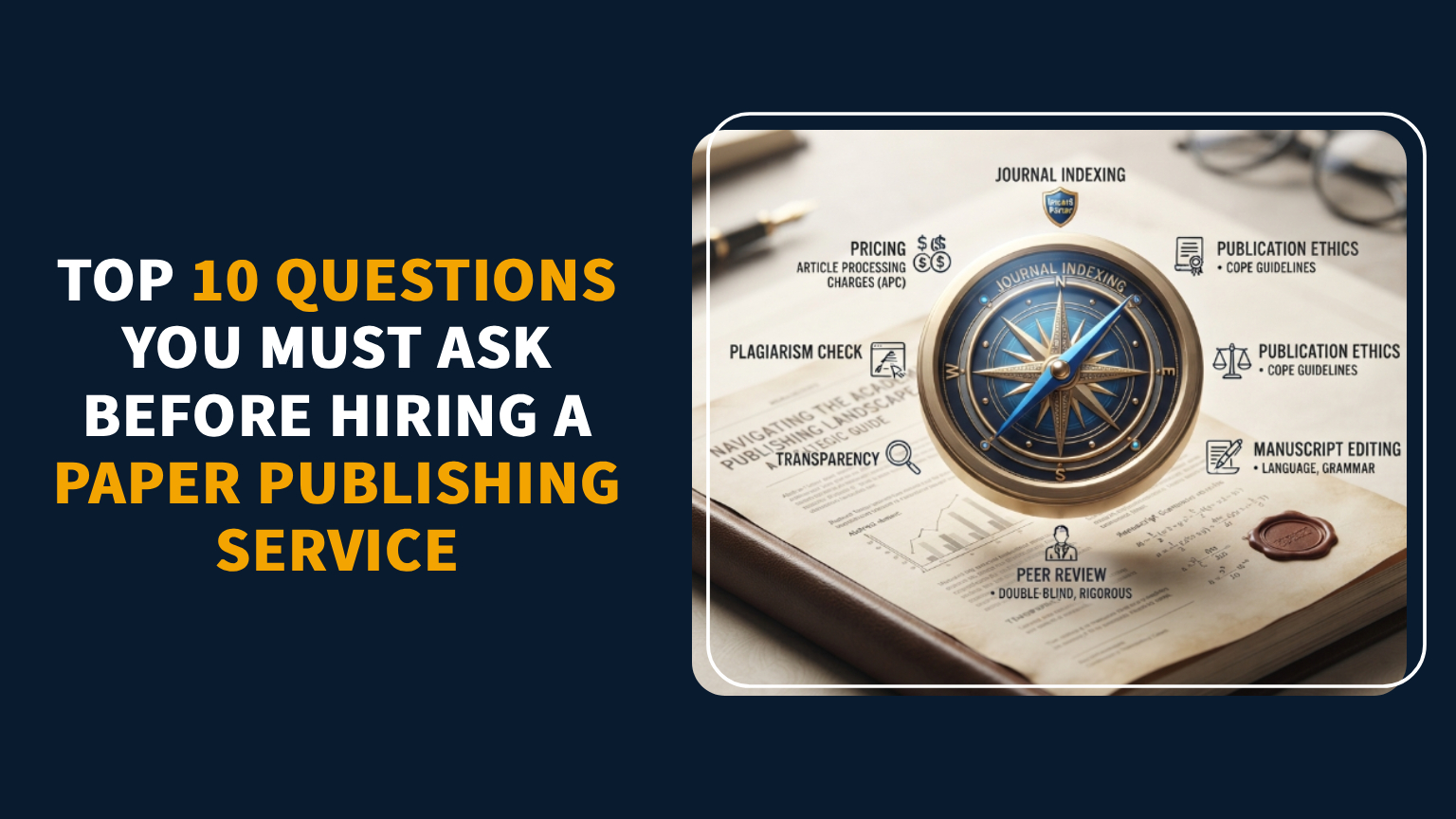
Before hiring any research paper publishing service, ask directly which indexed journals they actually publish in, whether they follow publication ethics guidelines, and what their real acceptance success rate looks like with verifiable examples. No legitimate service can promise guaranteed acceptance, any provider that does should be treated as a red flag, not a selling point.
If you’re a PhD student or early-career researcher weighing whether to bring in outside help with research paper publishing, the stakes are higher than picking a generic freelancer. A bad choice here doesn’t just waste money, it can mean submitting to a predatory journal that damages your academic credibility for years. A trustworthy provider will talk to you about publication ethics openly. This guide walks through the exact questions to ask before signing on with any publishing service, the red flags that should end the conversation immediately, and how to verify a provider is actually legitimate before you commit.
Why Choosing the Right Paper Publishing Service Matters
Risks of Hiring the Wrong Publication Service
The academic publishing space has a well-documented predatory journal problem, and services that promise fast, guaranteed placement are often the front door into it. Beyond wasted fees, researchers who unknowingly publish in predatory or non-indexed journals can face real consequences, work that doesn’t count toward tenure review, doesn’t appear in searches colleagues rely on, and in some cases actively damages a CV rather than strengthening it.
How the Right Service Impacts Journal Acceptance
A genuinely capable journal publication services provider doesn’t shortcut peer review, it strengthens everything within your control before submission: manuscript clarity, formatting compliance, ethical disclosures, and journal-fit selection. In our experience reviewing manuscripts before submission, papers that go through a structured pre-submission review consistently arrive at the desk-review stage in better shape, which is one of the few legitimate ways a service can help increase journal acceptance rates with publication support, without ever touching the actual peer review outcome itself.
Top 10 Questions to Ask Before Hiring a Paper Publishing Service
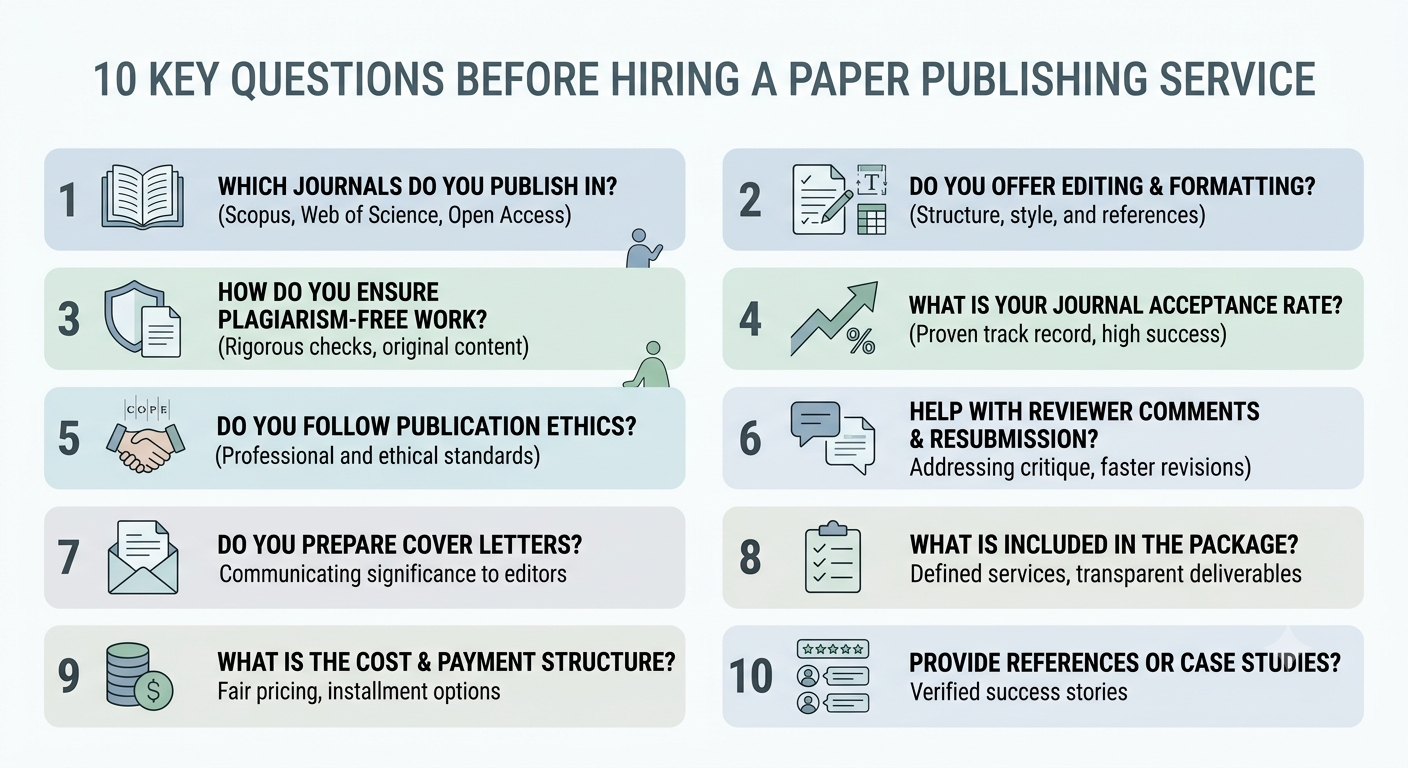
1. Which Journals Do You Publish In? (Scopus, Web of Science, SCI, Open Access)
Ask for a specific list of journals they’ve placed papers in recently, not a general claim of “international journals.” Cross-check those journal names directly against Scopus, Web of Science, or SCI databases yourself, don’t take the provider’s word for indexing status. A provider hesitant to name specific journals, or one who only offers a handful of unfamiliar titles, is usually signaling limited or low-quality placements.
2. Do You Offer Manuscript Editing and Formatting Support?
Confirm whether editing is included or billed separately, and ask who actually performs it, a subject-matter editor familiar with your field, or a generalist proofreader. This distinction matters more in technical or highly specialized fields, where a generalist editor can inadvertently introduce inaccuracies while “simplifying” technical language.
3. How Do You Ensure Plagiarism-Free Submissions?
A credible provider should describe a specific plagiarism-checking process, which software, what similarity threshold, and at what stage in the workflow. Vague reassurance without a described process is worth pushing back on, since plagiarism issues discovered post-submission can damage your standing with a journal far more than a delayed submission ever would.
4. What Is Your Journal Acceptance Success Rate?
Ask how this figure is calculated and over what time period, since publication success rate claims can be misleading if they include low-quality or predatory journals with near-universal acceptance. A meaningful figure should be broken down by journal tier or indexing status, not presented as a single blended number.
5. Do You Follow Publication Ethics Guidelines?
Confirm the provider follows recognized publication ethics standards, such as COPE (Committee on Publication Ethics) guidelines, covering authorship criteria, conflict-of-interest disclosure, and data integrity. Ask specifically how they’d handle a situation involving questionable data or an authorship dispute, the answer reveals a lot about how seriously ethics is actually treated internally.
6. Can You Help With Reviewer Comments and Resubmission?
Peer review almost always comes back with revision requests. Ask whether ongoing support through the revision and resubmission cycle is included, or whether it ends once the initial submission is filed, this single detail often separates a genuinely supportive service from one that disappears the moment payment clears.
7. Do You Provide Cover Letter Preparation?
A well-written cover letter can meaningfully affect how an editor initially frames your submission. Confirm whether this is a standard part of the service or an added extra, and ask to see an example cover letter template before committing.
8. What Exactly Is Included in Your Publication Package?
Get a written, itemized breakdown, editing, formatting, submission handling, plagiarism checks, revision support, rather than a bundled “full-service” description that leaves specifics unclear. Vague package descriptions are one of the easiest ways researchers end up paying extra for services they assumed were already included.
9. How Much Does Your Service Cost, and What Is the Payment Structure?
Ask whether payment is tied to milestones (submission, acceptance, publication) or charged entirely upfront. Full upfront payment with no milestone structure is worth extra scrutiny, particularly for early-career researchers working with limited grant or personal funding.
10. Can You Provide References or Verified Case Studies?
Request contactable references or case studies you can independently verify, not just testimonials posted on the provider’s own site, which are easy to fabricate. A brief email exchange with a past client is usually enough to confirm whether a provider’s claims match real experience.
Red Flags That Indicate an Unreliable Publication Service
Guaranteed Acceptance Claims
No legitimate provider can guarantee acceptance into a genuinely peer-reviewed journal, since the decision sits entirely with that journal’s independent editorial and review process. Treat any explicit acceptance guarantee as a serious warning sign, it usually means the “journal” in question either isn’t genuinely peer-reviewed or accepts submissions with minimal real scrutiny.
Lack of Transparency on Journal Indexing
If a provider is vague or evasive about which specific databases their placement journals are indexed in, that vagueness is usually deliberate, not accidental. Legitimate providers list specific journal names and indexing status openly, because that information holds up to scrutiny.
No Verifiable Track Record or Reviews
Services with no independently checkable history, generic testimonials, or a website with minimal identifying detail about the people behind it warrant real caution before any payment changes hands. A legitimate business is rarely difficult to identify, anonymity in this space is far more often a warning sign than a coincidence.
How to Verify a Trustworthy Research Paper Publishing Service
Check Journal Indexing Claims (Scopus, Web of Science)
Search the specific journal name directly in Scopus, Web of Science, or the DOAJ (Directory of Open Access Journals) rather than relying on a provider’s marketing page.
Look for Genuine Reviews and Testimonials
Search for the provider’s name alongside terms like “review” or “complaint” on independent forums and academic community spaces, not just the reviews featured on their own site.
Ask for Sample Work or Case Studies
Reputable research paper publishing services should be able to share redacted samples of past manuscript editing work or point to specific, verifiable published outcomes without hesitation. If the team behind the service can’t demonstrate they’re actual research publication experts, with relevant academic or editorial backgrounds, not just sales staff, that’s worth asking about directly before moving forward.
Benefits of Hiring Professional Publication Support
Faster and Smoother Journal Submission Process
A structured pre-submission review catches formatting and compliance issues that would otherwise cause delays or desk rejection.
Improved Manuscript Quality
Professional editing sharpens clarity and structure, particularly valuable for researchers writing outside their first language or submitting to a journal with strict style requirements. Working with genuine research publication experts, people who’ve actually navigated submission and revision cycles across your field, tends to catch issues a general editor would miss, from terminology precision to how a methods section is expected to read in your specific discipline.
Higher Chances of Acceptance
While no service can guarantee outcomes, addressing formatting, ethics disclosures, and manuscript clarity before submission removes several common, avoidable reasons for early rejection.
To Sum Up
Hiring the right research paper publishing partner comes down to asking direct questions and verifying the answers independently, rather than taking marketing claims at face value. The providers worth trusting are transparent about indexing, upfront about what they can and can’t influence, and comfortable being checked. If a service promises guaranteed acceptance, avoids specifics about journal indexing, or pressures you toward full upfront payment, treat those as reasons to walk away, not persistence to push past.
Frequently Asked Questions – FAQs
Is a paper publishing service worth it?
It can be, if the service focuses on manuscript quality, formatting, and ethical compliance rather than promising outcomes it can’t control, the value comes from preparation support, not shortcuts through peer review.
Can publication services guarantee journal acceptance?
No legitimate service can guarantee acceptance into a genuinely peer-reviewed journal, since that decision belongs entirely to the journal’s independent editorial process.
How do I avoid fake journal publishing companies?
Verify journal indexing directly through Scopus, Web of Science, or DOAJ, check for independently verifiable reviews, and be wary of any provider offering guaranteed or unusually fast acceptance.
How much does a paper publishing service cost?
Costs vary widely based on the scope of support, editing-only packages cost far less than full-service submission management, so always request an itemized breakdown before comparing providers.
Should PhD students use publication services?
Many PhD students benefit from professional editing and formatting support, particularly for a first submission, but should still independently verify any journal claims a service makes.
Are journal publication services legitimate?
Many are legitimate and genuinely helpful, but the space also includes predatory operators legitimacy comes down to transparency about journal indexing, ethics compliance, and realistic claims about what the service can influence.