A well-researched manuscript can still be rejected for reasons that have nothing to do with the quality of the research itself: the wrong journal, a missed formatting rule, or a cover letter that undersells the contribution. This is the gap that costs researchers months, and it’s exactly where journal publication support earns its place alongside strong research writing.
Researchers often assume they need one or the other: help perfecting the manuscript, or help navigating the submission process. In reality, these are two different skill sets solving two different problems, and relying on only one leaves the other half of the journey unmanaged.
This guide walks through what each type of support actually covers, why neither one alone is sufficient, and how combining research support with journal publication services changes the odds of acceptance.
The distinction matters because the two problems require genuinely different skills. Strengthening an argument, tightening prose, and verifying ethics compliance call for editorial and subject-matter expertise. Matching a manuscript to the right journal, meeting formatting specifications, and framing a submission for an editor call for familiarity with publishing norms and editorial expectations. Few researchers are equally strong in both, which is exactly why treating them as one connected process, rather than two separate afterthoughts, tends to produce better results.
What is Research Support for Researchers?
Research support covers everything that happens before a manuscript is ready to leave the researcher’s hands: the writing, structuring, and quality checks that determine whether the underlying work is presented as clearly as it deserves to be.
Manuscript Preparation and Academic Writing Support
This includes structuring the manuscript around a clear research question, organizing sections logically, and translating dense findings into readable academic prose. For many researchers, especially those writing in a second language, this stage is where the actual argument of the paper either comes through clearly or gets lost in translation.
Research Manuscript Editing and Proofreading
Editing catches inconsistent terminology, unclear sentence structure, and logical gaps between sections. Proofreading catches the smaller errors, grammar, punctuation, and formatting slips, that reviewers notice even when they don’t affect the science itself, but still shape their overall impression of rigor.
Plagiarism Checking and Ethics Compliance
Before submission, a manuscript should be checked against plagiarism detection tools and reviewed for ethics compliance, proper citation, appropriate consent documentation, and disclosure requirements. Skipping this step risks a rejection that has nothing to do with the research findings themselves.
What Are Journal Publication Services?
Journal publication services pick up where manuscript preparation ends: everything involved in getting a finished draft in front of the right editors, in the right format, with the right supporting materials.
Journal Selection Assistance
Choosing a journal isn’t just about prestige, it’s about matching the manuscript’s scope, methodology, and audience to a journal that actually publishes that kind of work. A mismatched submission is one of the most common, and most avoidable, reasons for a fast rejection.
Get your work recognized on global research platforms with our expert guidance TODAY!
Formatting and Citation for Journal Submission
Every journal has its own formatting rules, citation style, word limits, figure requirements, section order. Manuscript formatting support ensures the submission meets these requirements exactly, rather than risking a desk rejection over a technicality unrelated to the research.
Cover Letter Preparation and Submission Support
A strong cover letter frames the manuscript’s contribution for an editor deciding whether it’s even worth sending to reviewers. Submission support also covers navigating the journal’s portal, tracking submission status, and responding to editor queries, the administrative layer of the journal publication process that’s easy to underestimate until you’re managing it for the first time.
Research Support vs Journal Publication Services: How They Differ
Seeing the two side by side makes the distinction, and the case for using both, much clearer.
| Aspect | Research Support | Journal Publication Services |
|---|---|---|
| Primary focus | Manuscript quality and clarity | Journal fit and submission process |
| Typical tasks | Writing, editing, proofreading, ethics checks | Journal selection, formatting, cover letters, submission tracking |
| Stage of the journey | Before the manuscript is finalized | After the manuscript is finalized |
| Main risk if skipped | Weak manuscript, unclear argument | Wrong journal fit, formatting rejections |
| Best suited for | Strengthening the research itself | Navigating editorial and submission requirements |
Why Research Support Alone Isn’t Enough
Gaps Between Writing and Submission
A polished manuscript still has to clear an entirely separate set of hurdles: finding the right journal, meeting its specific formatting rules, and framing the submission convincingly. Research support doesn’t cover any of this by design, which leaves a real gap if nothing fills it.
This gap tends to surface at the worst possible moment: after weeks of writing and revision, when the researcher is ready to submit and suddenly has to research journal scope, decode formatting instructions, and draft a cover letter from scratch, often under deadline pressure.
Common Reasons Well-Written Papers Still Get Rejected
Editors reject well-written manuscripts for reasons unrelated to writing quality: the topic falls outside the journal’s scope, the formatting doesn’t match submission guidelines, or the cover letter fails to make a clear case for relevance. None of these are writing problems, they’re submission-strategy problems.
A desk rejection on these grounds costs the same weeks or months as a substantive one, without offering any feedback on the research itself, which makes it one of the more frustrating outcomes a researcher can face.
Why Journal Publication Services Alone Aren’t Enough
Weak Manuscripts Reduce Acceptance Chances
No amount of formatting precision or journal-matching expertise can compensate for a manuscript with an unclear argument, inconsistent methodology reporting, or unaddressed ethics gaps. Submission support can get a weak manuscript in front of the right editor, it can’t make the underlying paper stronger.
In practice, this means a manuscript can be submitted to a perfectly matched journal, formatted flawlessly, and still be rejected at peer review if the underlying argument doesn’t hold up, the submission strategy did its job, but the manuscript wasn’t ready to carry it.
Why a Strong Research Foundation Matters Before Submission
Reviewers evaluate substance, not just formatting. A manuscript needs a clear contribution, a defensible methodology, and readable prose before submission-side support can do its job effectively. Manuscript publication services work best when they’re building on a manuscript that’s already sound.
This is why sequencing matters: research support should come first, ideally with enough runway before a submission deadline for meaningful revision, rather than being squeezed in after a journal has already been chosen.
How Research Support and Journal Publication Services Work Together
From Manuscript Preparation to Successful Publication
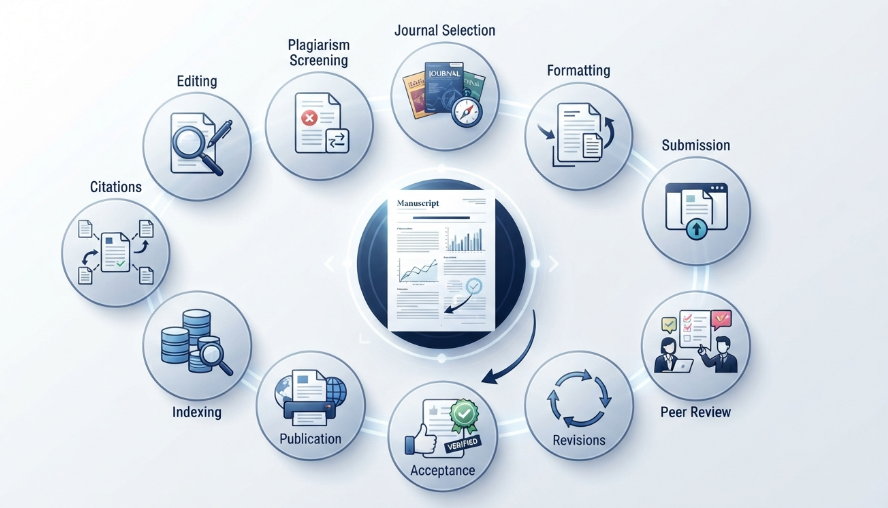
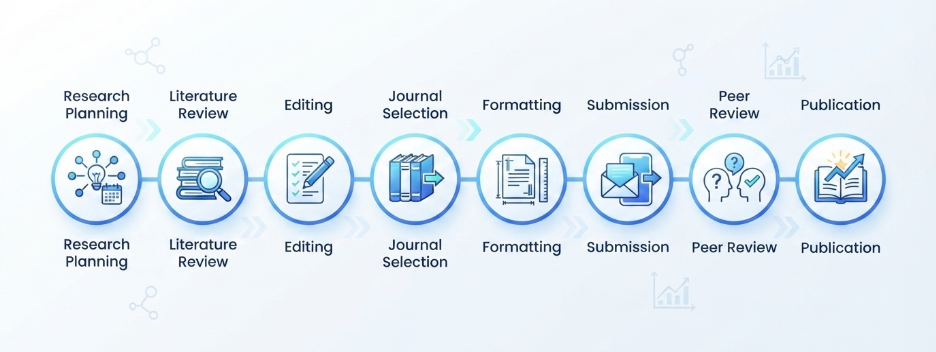
When both types of support are coordinated, the manuscript moves through writing, editing, journal selection, formatting, and submission as one continuous process, rather than as two disconnected efforts handled by different people at different times with no shared context.
End-to-End Support Across the Research Journey
This is where research and journal publication services genuinely complement each other, one strengthens the manuscript itself, the other manages its path to the right editor’s desk, and together they cover the full distance between a research question and a published article.
Key Benefits of Combining Both Services
Higher Journal Acceptance Rates
A manuscript that is both well-written and well-matched to its target journal has a meaningfully better chance of clearing initial editorial screening, since it avoids the two most common early rejection triggers at once.
Reduced Revision Cycles and Reviewer Rejections
Combined support catches issues, unclear methodology sections, inconsistent formatting, before submission rather than after a reviewer flags them, which shortens the overall path to acceptance.
Time and Effort Savings for Researchers
Coordinating writing, editing, and submission through one connected process saves researchers from managing two separate vendors, timelines, and sets of instructions on their own.
Consistent Quality from Draft to Publication
When the same standards guide both the manuscript and its submission package, the final output reads as one coherent, professional piece of work rather than a patchwork of disconnected edits.
Who Needs Both Research Support and Journal Publication Services?
PhD Students
Doctoral candidates are often publishing for the first time while juggling coursework, teaching, and dissertation deadlines. Publication assistance for researchers at this stage helps translate strong dissertation chapters into submission-ready journal articles without adding months to an already tight timeline. Reliable publication support for PhD students is often the difference between a chapter that stays in a drawer and one that becomes a first publication.
Early-Career Researchers
Early-career academics are frequently judged on publication output before they’ve built deep familiarity with journal norms and editorial expectations. Combined support shortens that learning curve considerably, and publication support for PhD students transitioning into postdoctoral roles carries similar value in this phase.
Faculty Members with Heavy Workloads
Established researchers often have strong manuscripts but limited time to manage journal selection, formatting, and submission logistics alongside teaching and administrative duties. Publication assistance for researchers at this level is less about writing help and more about reclaiming time.
How to Choose a Provider Offering Both Services
Look for a provider that treats research support and submission support as one connected service rather than two separate transactions. Ask specifically whether they offer end-to-end publication services, covering writing support, editing, journal selection, formatting, and submission tracking under a single, coordinated process. It’s also worth confirming their familiarity with your specific discipline’s leading journals, since generic manuscript publication services without subject-matter familiarity often struggle with journal-fit recommendations. A provider offering genuine academic research support should be able to speak concretely about your field’s methodology conventions, not just general writing quality.
A few practical questions can separate a genuinely connected provider from one bundling two unrelated services under one invoice: Do the same reviewers who edit the manuscript also advise on journal selection? Is there a single point of contact across both stages? And can they show examples of manuscripts they’ve supported from first draft through to acceptance, rather than only one half of that journey? Providers offering real end-to-end publication services should answer all three without hesitation.
Final Words
Research support and journal publication services solve different problems, and neither fully covers the other’s gap. One strengthens the manuscript itself; the other manages its path through journal selection, formatting, and submission. Researchers who combine both typically move through the process faster, face fewer rejections tied to avoidable issues, and spend less time managing two disconnected efforts on their own.
If you’re preparing a manuscript for submission, it’s worth evaluating whether your current support covers the full journey, or only half of it.
Frequently Asked Questions (FAQs)
Why Do Researchers Need Publication Services?
Publication services handle journal selection, formatting, and submission logistics, tasks that are separate from writing quality but still directly affect whether a manuscript gets accepted.
Research Support vs. Journal Publication Services — What’s the Difference?
Research support strengthens the manuscript itself through writing and editing; journal publication services manage everything involved in submitting that manuscript to the right journal.
Can Publication Services Increase Journal Acceptance?
Yes, by matching manuscripts to suitable journals and ensuring formatting compliance, publication services reduce the avoidable rejections that have nothing to do with research quality.
Who Should Use Research Publication Services?
PhD students, early-career researchers, and busy faculty members all benefit, particularly when they’re publishing frequently or navigating journal norms for the first time.
What Is Included in Journal Publication Services?
Typically, journal selection, formatting and citation alignment, cover letter preparation, and submission tracking through to editorial decision.
How Can I Improve My Chances of Journal Acceptance?
Combining a well-edited, ethically compliant manuscript with careful journal selection and formatting accuracy, addressing both sides, closes most avoidable rejection reasons.