You spent months on your research. You read hundreds of papers, ran your experiments, analysed your data, and finally wrote it all up. Then you submitted it to a journal. And got rejected. Sound familiar?
You are not alone. Studies show that rejection rates at top peer-reviewed journals regularly exceed 80 to 90 percent. According to a 2022 analysis published in Learned Publishing, one of the most common reasons editors and reviewers reject manuscripts is not the quality of the research itself. It is the quality of the writing and presentation. That is where academic editing for research publication becomes less of a luxury and more of a necessity.
This article breaks down exactly how professional academic editing strengthens research papers, what the process involves, and why it matters more than most researchers think.
Why Your Research Paper Deserves More Than a Spell Check
Here is the honest truth: Microsoft Word’s spell checker will not save you from a journal rejection.
Spell checkers miss context. They miss logic gaps. They miss whether your Methods section actually supports your Results. They miss whether your abstract gives reviewers a clear reason to keep reading. A human academic editor, on the other hand, catches all of this.
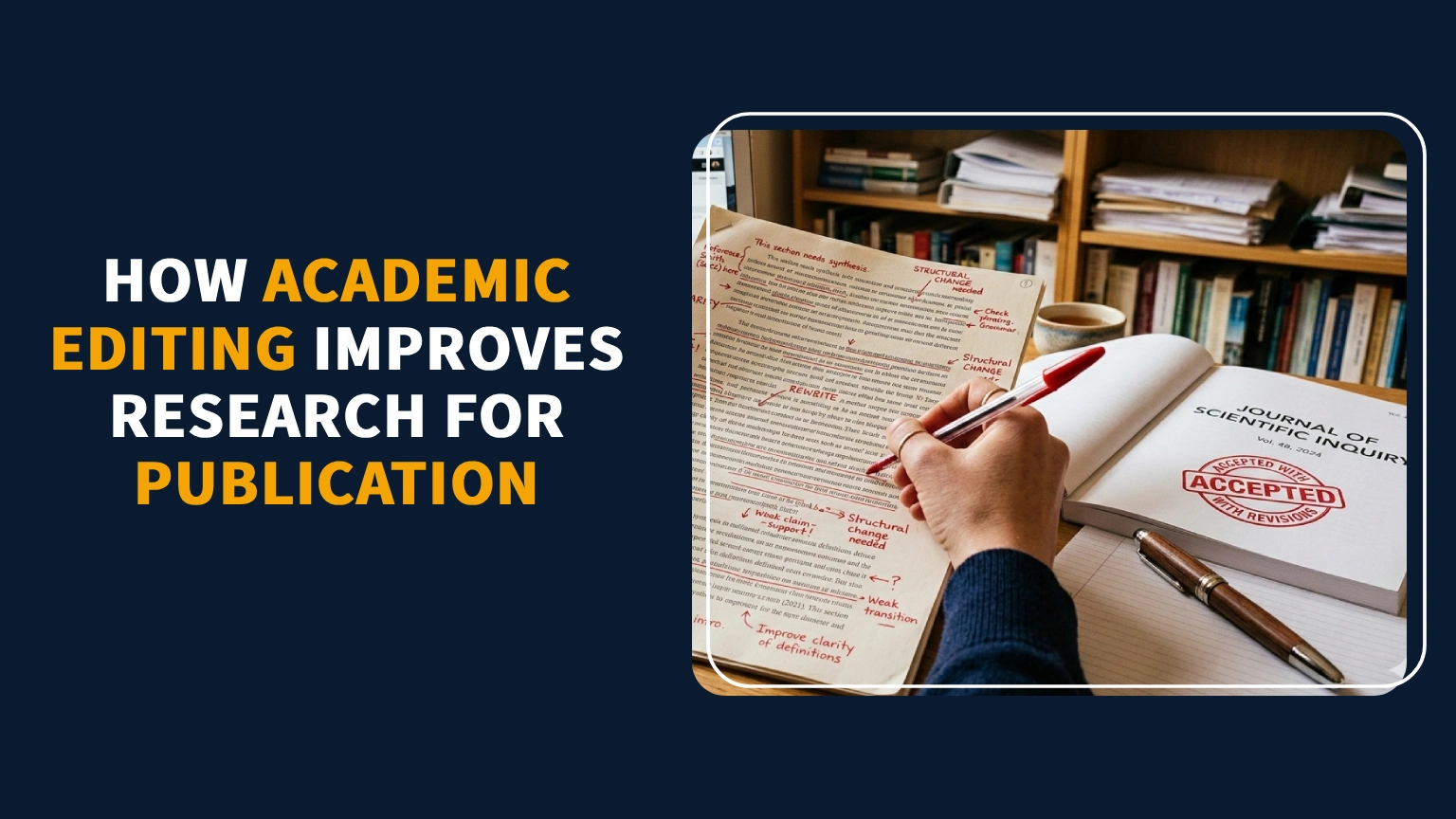
Research paper editing goes far beyond grammar. It covers clarity of argument, consistency of terminology, logical flow between sections, adherence to the target journal’s style guide, and the overall coherence of your scientific narrative.
The difference between a polished manuscript and a rough draft is often the difference between acceptance and rejection. That is not an exaggeration. A 2021 report by the Committee on Publication Ethics (COPE) highlighted that poor manuscript presentation is one of the most frequently cited desk-rejection triggers in academic publishing.
What Professional Academic Editing Actually Covers
Let us get specific. When a researcher engages professional academic editing services, they are not just paying for someone to fix commas. Here is what a thorough editorial review actually includes:
Structural and Logical Clarity
Every research paper follows a structure: Introduction, Literature Review, Methodology, Results, Discussion, and Conclusion. An academic editor checks whether each section does its job. Does the Introduction build a compelling case for why the research matters? Does the Discussion interpret results rather than just repeat them? These are structural questions that shape whether a reviewer keeps reading.
Language and Style Precision
Academic writing demands precision. Vague language, ambiguous phrasing, and imprecise terminology can undermine an otherwise strong study. Editing for research papers tightens language, eliminates redundancy, and ensures your scientific vocabulary stays consistent from page one to the references.
Journal-Specific Formatting
Different journals have different requirements. Nature uses a different referencing style than the Journal of the American Medical Association. Word count limits, figure caption formats, and citation styles all vary. A professional editor familiar with your target journal can format your manuscript correctly before submission, saving you weeks of revision time.
Abstract and Title Optimization
Your abstract is your paper’s first impression. Most reviewers decide within the first two paragraphs whether a manuscript is worth their time. A well-edited abstract is concise, complete, and accurately represents the study. Your title should be clear, searchable, and specific. These two elements alone can determine whether your paper even reaches the peer-review stage.
The Real Cost of Skipping the Editing Step
Some researchers skip editing to save time or money. It rarely pays off.
Consider this: a desk rejection from a top journal sets your publication timeline back by months. You then revise and resubmit somewhere else. More months pass. All of that could potentially be avoided by investing in proper research publication editing before the initial submission.
Beyond rejection, poorly edited papers that do get published can damage your professional reputation. Errors in published research are not easily forgotten. The scientific community notices. Retraction Watch, a database tracking retracted scientific papers, consistently links poor documentation and ambiguous reporting to editorial failures that should have been caught before submission.
The cost of professional academic editing services is almost always lower than the cost of a missed publication cycle.
Get your work recognized on global research platforms with our expert guidance TODAY!
Editing vs Proofreading: Understanding the Difference
Many researchers use these terms interchangeably. They are not the same thing, and confusing them can lead to under-preparing a manuscript.
Proofreading is the final surface check. It catches typos, punctuation errors, and formatting inconsistencies. It is the last step before submission, not the only step.
Editing is deeper and more comprehensive. It addresses structure, argument, clarity, and coherence. It asks whether the paper makes sense, not just whether it is grammatically clean.
Think of it this way: proofreading is checking whether the paint job looks right. Editing is making sure the house is structurally sound. Both matter, and the sequence matters too. You always edit before you proofread, not the other way around. If you want a deeper look at how both processes work together, this guide on Editing and Proofreading explains the distinction clearly and gives practical steps for applying each effectively.
How Editing Before Journal Submission Improves Acceptance Rates
The relationship between editing and acceptance is not just anecdotal. Several studies and publishing organizations have documented it.
A 2019 study published in the journal PLOS ONE found that manuscripts submitted with clearer language and better structure received significantly more favorable peer-review scores, even when the underlying research quality was comparable to less-polished submissions. The study concluded that how research is communicated has measurable impact on how it is evaluated.
Editing before journal submission addresses the exact factors that peer reviewers use to evaluate manuscripts. Reviewers assess clarity, completeness, logical consistency, and adherence to scientific reporting standards. A professional editor aligns your manuscript with all of these criteria before any reviewer sees it.
This is not about gaming the system. It is about giving your research the presentation it deserves.
What to Look for in a Research Paper Editing Service
Not all editing services are created equal. Choosing the right one matters as much as choosing to edit at all.
Look for services that employ editors with subject-matter expertise in your field. A general copyeditor may improve your grammar but will miss disciplinary conventions that matter to your reviewers. An editor with a background in your field understands your terminology, your methodology, and your audience.
Also look for services that offer journal-specific editing. If you are targeting a specific journal, your editor should know that journal’s scope, style, and expectations.
Turnaround time, revision policies, and confidentiality guarantees are also worth checking. Many reputable journal article editing services offer sample edits so you can assess quality before committing.
Academic proofreading services should also be evaluated for their process. Do they provide a clean copy and a tracked-changes version? Do they offer editorial comments explaining their changes? These features help you learn from the process, not just submit a cleaner manuscript.
The Role of Language Editing for Non-Native English Speakers
A significant portion of the global research output comes from researchers who write in English as a second or third language. For these researchers, professional editing is not optional. It is essential.
English-language journals expect a certain standard of academic writing. Reviewers are not always patient with manuscripts that require substantial language revision, even if the science is strong. In fact, many journals explicitly state in their submission guidelines that manuscripts with poor English may be rejected without review.
Language editing services specifically designed for non-native speakers focus on natural academic phrasing, idiomatic correctness, and discipline-appropriate vocabulary. They preserve the researcher’s voice while elevating the manuscript to native-level fluency standards.
Organizations like the American Journal Experts (AJE) and Editage report that manuscripts submitted after professional language editing receive more favorable initial assessments from editors, particularly at high-impact journals.
Editing as a Strategy, Not Just a Formality
The most successful research teams treat editing as a strategic step in the publication process, not an afterthought. They build editing time into their submission timelines. They allocate budget for professional editing services. They treat manuscript quality as seriously as research quality.
This mindset shifts changes outcomes. When editing is treated as a core part of the research publication workflow rather than an optional polish, manuscripts arrive at journals in a fundamentally stronger position.
If you want to understand how editing directly influences Research Paper Acceptance rates and what specific editorial changes make the biggest difference, reviewing targeted resources on acceptance strategy can help you prioritize your pre-submission checklist.
The researchers who publish consistently in high-impact journals are rarely the ones with the most groundbreaking ideas alone. They are the ones who communicate those ideas with precision, clarity, and professionalism.
Final Thoughts on Improve Research Paper Quality Through Editing
Good research deserves to be read. It deserves to reach the audience it was designed for. And it deserves a fair chance at publication in the journals where it can create the most impact.
Academic editing for research publication is the bridge between research that sits on your hard drive and research that shapes its field. It is not a shortcut. It is due diligence.
Whether you are a doctoral student preparing your first submission or an experienced researcher targeting a tier-one journal, investing in professional editing before submission is one of the most rational decisions you can make. The data supports it. The publishing community endorses it. And your research deserves it.
Take your work seriously enough to present it at its absolute best. That is what editing is for.